
The product life cycle is a concept that many departments within a company work with. Some of you may be wondering: why does it matter, and should I know about it? If we understand this concept and keep it in mind, we will make smarter, more effective decisions in our business.
What is the product life cycle?
The term refers to the journey a product takes from its launch until it is withdrawn from the market, as it reaches and passes through the hands of its users.
The product life cycle as such goes through 5 phases, from the moment it is introduced to the market until it disappears, that is, until it is no longer sold.
Who benefits from understanding the phases a product goes through?
The product life cycle is managed by several departments; in other words, each one will act differently depending on the phase the product is in.
The marketing and advertising department uses it to build advertising strategies that reach different segments, capture larger customer audiences… and it helps them understand customer needs at all times.
Product managers, on the other hand, use the product cycle to decide whether to add features to the product, how much to invest, or what maintenance is required at each phase.
To close this point, we will now explain the different phases a product goes through, looking at it both from a marketing, advertising and sales perspective and from the product manager’s point of view.
What are the phases of the product life cycle?
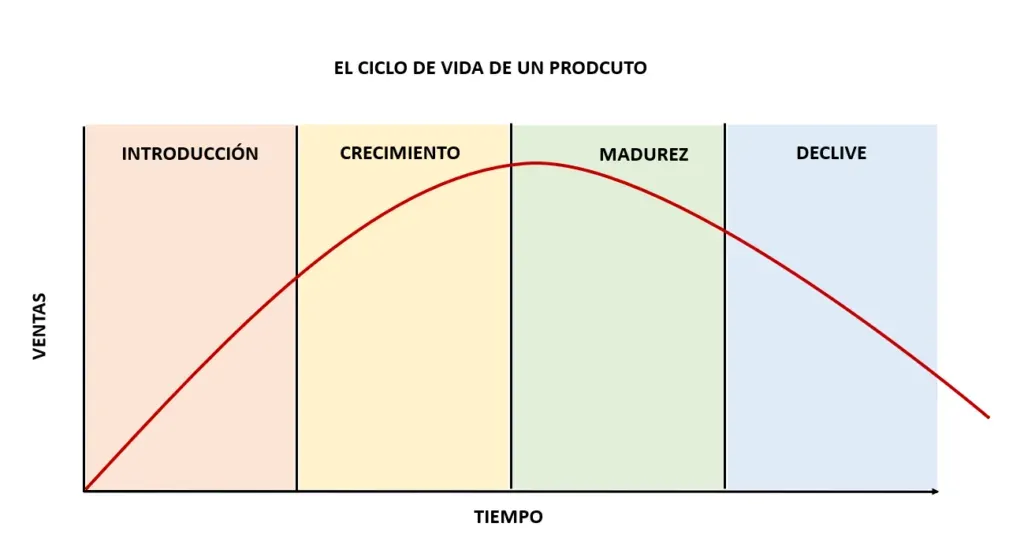
The different phases — introduction, growth, maturity and decline — are a guide that applies to all products in general. We are not talking about specific products or brands. It is worth noting that there are many cases where products do not follow this cycle so clearly. Even so, it remains the main pattern that most companies follow.
Product development
We will not include product development within the 4 phases of the product cycle, since it is a stage that comes before it. Even so, let’s review what we should keep in mind when developing an item.
When we develop a product, we need to have clearly defined the benefits it delivers to the end consumer. The end user, in turn, values the various attributes our product will have at the moment we launch it on the market.
- Quality: Depending on the positioning we aim for in the market, a product’s quality is associated with the value the customer perceives, and we must achieve full satisfaction in the consumer.
- Features: This is a factor that makes our product stand out from the competition, which is why we must look for this competitive advantage when launching new products on the market. It is important to study the competition to know which features set us apart and how we can differentiate ourselves from them. What different value does our product bring?
- Style: A product’s style can be defined in many ways, but we will focus on a product’s appearance — whether it strikes us as attractive or dull. Good style captures consumers’ attention and guarantees a good shopping experience.
- Design: Design differs from style in that it is a deeper concept. Good design contributes to the product’s usefulness and its presence in the market; it goes beyond style.
1. Introduction phase
This stage represents the launch of the product you intend to present to the market. The goal in this phase is to make the product known. It is common here for marketing and informative advertising costs to be high, since we want to reach larger audiences and introduce our product to consumers. Sales grow slowly, and losses can even occur during the process.
Product prices are usually higher than normal in order to cover these costs.
2. Growth phase
Once we get past the introduction phase, the audience accepts our product. In the growth phase, sales grow more and more, the product has been accepted by customers, and market share increases. At this stage, pressure from competitors rises and we need to step up the activities associated with the products. The goal in this phase is to enhance the product’s features to improve them and stand out from competitors. Advertising shifts from informative to persuasive, because now I have to convince consumers that my product is the best on the market — I no longer need to explain what the product is and what benefits it brings (as in the introduction phase).
In this phase it is also vital to nurture and build relationships with already established distributors. Because without efficient distribution, it is impossible to hold a strong, flexible position in the market.
3. Maturity phase
This stage is defined by stable sales and profits. We no longer see vertical sales growth, since most consumers have already tried the product. As a result of that strong acceptance, repurchasing begins. Because we still have plenty of sales overall, pressure from competitors does not ease either, and companies fight to win customers. One of the goals at this stage would be to reach more segments within the same market, introducing new features or different attributes — for example, Coca-Cola Light or caffeine-free, which reaches an audience that regular Coca-Cola did not previously capture.
Advertising focuses on keeping the brand top of mind and standing apart from the competition. Consumers tend to demand the same quality at the best possible price.
4. Decline phase
Sales in maturity were at their peak. In the decline phase, new products start to appear on the market that better satisfy consumers, and demand for ours falls. As we have less activity — and if the competition is going through similar phases — we will face less pressure in the market and marketing costs will be lower. Generally, the price drops much lower, and merchants tend to make payments easier and offer discounts or promotions.
Faced with this situation, the company has two options:
-
Exit the market: If we decide to leave the market, we will incentivize consumers with tools such as special offers to raise money that we will use for other company activities.
-
Stay in the market: Other competitors choose to stay in the market, study the competition, and improve the product.
The consumer’s point of view
We have been able to see the product cycle and the role the different departments play in each phase. It is important to understand the term in order to avoid redesigns and unnecessary steps in the product process. We cannot leave consumers out of the equation, since all of our actions are aimed at the satisfaction they ultimately experience.
What role do consumers play in the product life cycle?
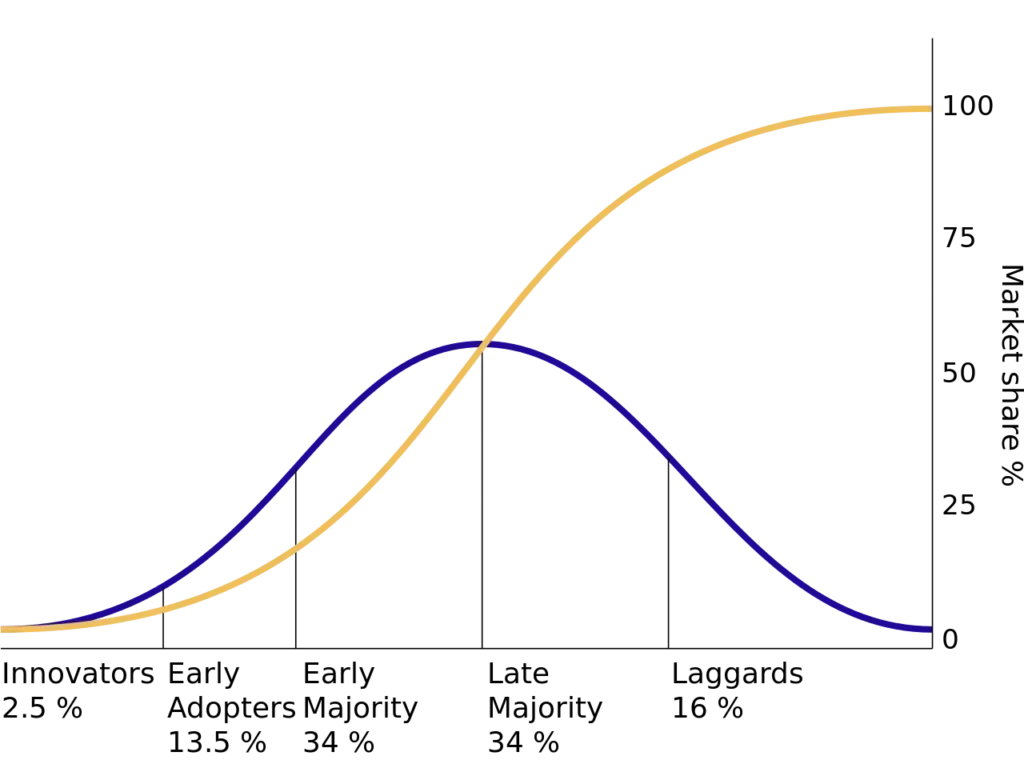
Many of you will recognize this chart: it is the innovation or technology adoption curve, also known as the Rogers curve. As we will see, it divides the different population segments depending on their relationship with technology.
In this chart, the yellow line represents the percentage of the market until it reaches 100, which indicates saturation. The blue curve, on the other hand, indicates the users who are adopting the new product.
- Innovators
These are people willing to experiment with innovation, aiming to dig into the product and discover all of its features. They are technology lovers and, in many cases, are chosen to provide feedback during the product’s development process. We must bear in mind that they are a small segment of consumers, but we should never overlook them.
- Early adopters
Also known as early adopters, these are consumers who want to be among the first to try products. Innovation appeals to them and they seek to set themselves apart from the majority, which is why we find them in phase 1 of our cycle: the introduction.
- Early majority
The early majority encompasses a large part of the population. They are known for taking the step to buy our product only if it has first been recommended or tried by the early adopters. When the early majority bets on the product and it becomes a trend, we are in the growth phase.
- Late majority
These are people who play it safe; it is also a large group that resists change. They prefer to stay on safe, comfortable ground before trying new products. They do not decide to buy our product until it has entered the maturity phase, where they can rely on the opinion of the vast majority and enjoy discounts and comparisons across the competition. They are cautious people who analyze before buying anything.
- Laggards
This is a small group that holds them back from trying new products. They are very skeptical people who cannot be convinced by any means. Novelty repels them and they are not willing to pay for what is on offer. They prefer cheaper alternatives or simpler solutions.