

Why is everyone talking about the conversion funnel?
For many people, the e-commerce funnel is a mystery, yet it’s essential for understanding the steps a digital consumer takes.
It’s a term used in digital marketing to define the different steps a user follows. Generally, it’s broken down into four stages. It starts with the first stage, where potential customers look for information about products, and ends when they complete a final action.
So first, it’s important to set a final goal or action. If we’re an online retail store, our final goal would be for people to buy our product, right? Another goal could be signing up for the newsletter, calling us on the phone, or becoming a member.
The beauty of sales funnels is that they’re shaped like a funnel, just as the name suggests. Throughout the 4-stage process, customers gradually drop off. It’s a very useful way to analyze where we’re losing customers and to find a solution so they move to the next stage and end up meeting our final goal.
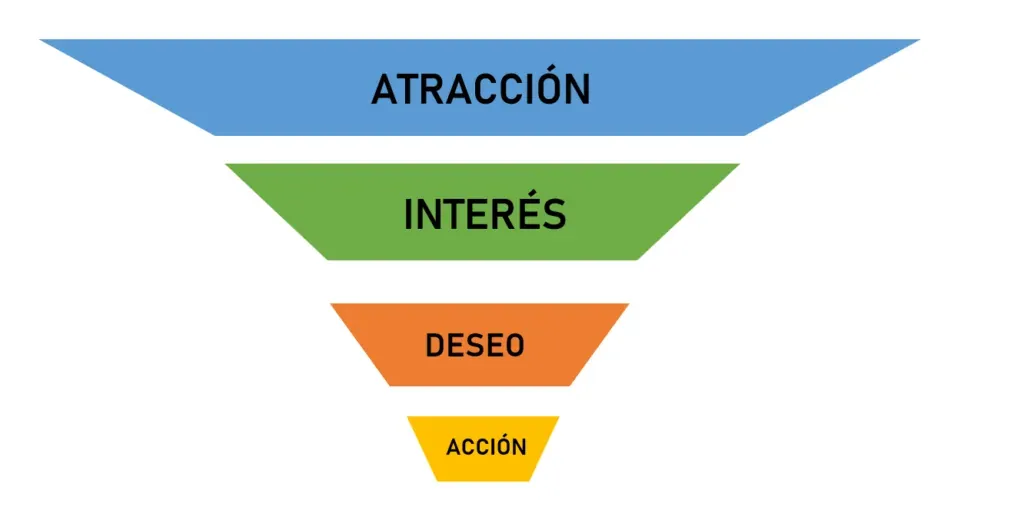
The 4 steps of the sales funnel are
1- Website visits, browsing
The first step is the users who find us online while browsing, searching for online stores that sell t-shirts, for example. In this stage, the most important thing is to spark customers’ ATTRACTION to our page with:
- Loading speed
- Website structure
- Image optimization and SEO
- Keywords
- Thematic selection
- Clear information and structure
2- Decision-making
In this stage, we have the customers who have found our website (fewer than in the first stage) and have decided to stay. They start to get curious about the products we sell. It’s very important to spark their INTEREST until they find products they want to add to the shopping cart. The following methods inspire more interest:
- Customer support that’s always visible
- Visibility of promotions and discounts
- Pleasant store design
- Product presentation
- Well-written copy
- Fast website loading
- High-quality images
- An “About us” page
3- I need it
In the third stage, fewer customers end up with a cart full of products. Here we’ve already sparked the DESIRE to own the products. In this final stage, it’s very important to have secure payment methods and to inspire trust in customers, since they’ll be providing their personal data. One way to do this would be:
- Providing product information: price, delivery time, detailed information, shipping costs, privacy policy, and return policy.
- Payment security, offering as many secure payment options as possible.
- Visible trust and security guarantees.
- In the cart, it’s important to indicate the steps to follow and include a link to the product throughout the process.
- At checkout, include an image of the product with the price and shipping costs.
- Give the customer the option to get in touch with us.
4- Conversion
The last stage would be the ACTION of buying the product. Once the customer has bought the product, it’s important to ask for feedback through a satisfaction survey so you can improve the service.
This is also where you evaluate after-sales service. Good support during product delivery will help build customer loyalty for future online purchases.
See the article Tips to build customer loyalty in your e-commerce