

Marketplaces keep gaining ground in the market and, during the pandemic, they were the leading online sales channel. Here we’ll look at some findings from the 2021 marketplace study by TandemUp.
A marketplace is a type of eCommerce that lets multiple sellers connect with buyers to complete a commercial transaction. Buyers and sellers stay within the marketplace environment until the transaction is finished.
24.3 million Spaniards have bought on a marketplace at some point, which is equivalent to 72% of the population and represents 100% of online shoppers. For 98% of them, it is their main eCommerce channel for shopping.
Here’s what this blog post covers:
- What are their shopping habits?
- Which categories sell the most?
- What is their brand awareness? And their market penetration?
- How do shoppers access marketplaces?
- The Amazon effect
- The most striking conclusions
1. Who is the marketplace shopper?
They are both men and women, 39 years old on average. The Madrid and Barcelona areas account for 25% of the total.
2. What are their shopping habits?
Purchase frequency is 13 times a year, which is close to once a month. Their average order value rises from €50 to €64, although the interval with the highest share is between 25 and 50 euros.
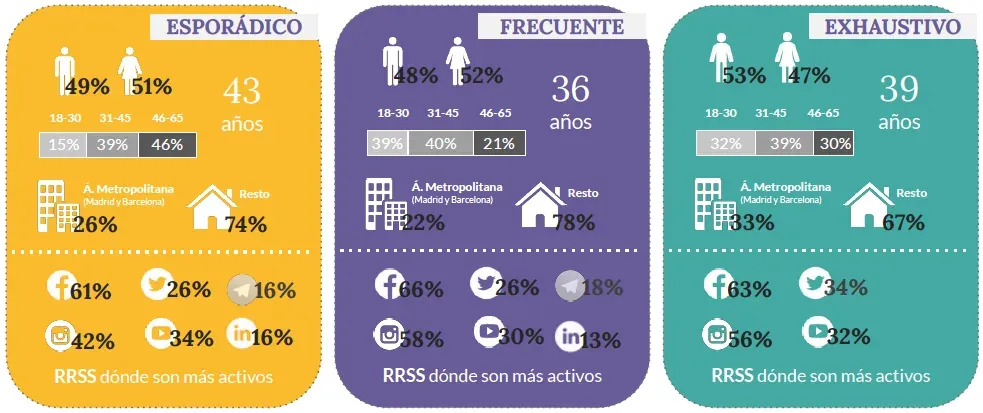
We can identify 3 types of marketplace shopper based on their buying intensity in terms of frequency and average order value:
15% heavy buyers: 13.6 times/year and €178 per purchase
43% frequent buyers: 20.4 times/year and €45.80 per purchase
46% occasional buyers: 5.2 times/year and €50.0 per purchase
3. Which categories sell the most?
The best-selling categories on marketplaces are: home, electronics, clothing and footwear, books, film and music, and computing. The number of categories has grown to 5.8, compared with 5.3 in 2020.
Amazon, AliExpress, El Corte Inglés, Ebay, and Carrefour cover more product categories, unlike the specialized ones (La Casa del Libro, Zalando, and Leroy Merlin).
Fnac stands apart, positioning itself between two worlds: books and other products (such as stationery, computing, and toys).
4. What is their brand awareness? And their market penetration?
On average, shoppers recall 9.5 marketplaces. Among them, the most prominent is Amazon, followed by Ebay, AliExpress, El Corte Inglés, Carrefour, Leroy Merlin, Zalando, Fnac, Casa del Libro, Wish, and Privalia.
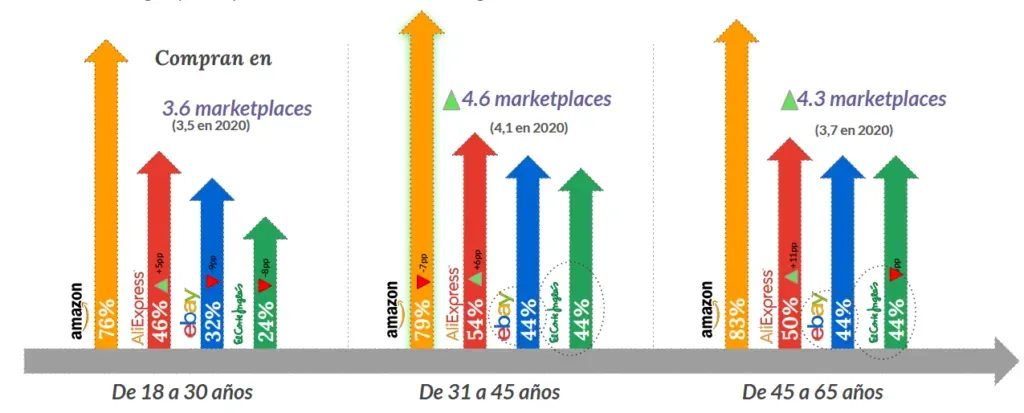
The image shows penetration by year, where we can see that Amazon wins across the board. Another finding is that men diversify their options more, while women focus on Amazon, AliExpress, and specialized marketplaces.
Amazon is the marketplace with the most loyal customers; most of its consumers have shopped on 4.7 other marketplaces.
The highest average order value goes to Carrefour and El Corte Inglés, although Amazon has the highest purchase frequency, at 16.6 times a year.
Ideally, what customers look for in marketplaces comes down to 5 key aspects: free shipping, affordable product prices, overall product quality, deals and promotions, and ease of returns or complaints.
5. How do shoppers access marketplaces?
Most marketplaces are accessed through the website. Amazon and AliExpress are the only ones growing on app, while the others don’t compete.
AliExpress’s app market share in terms of downloads is still ahead of Amazon. The app is used to track orders and rate products.
6. The Amazon effect:
Amazon is synonymous with a wide selection, speed, affordability, safety, quality, and trust. It is the first eCommerce choice; however, if shoppers don’t buy on Amazon, their alternative is the physical store rather than another eCommerce site.
Returns are easy. After long years of difficult product returns across most online purchases, Amazon worked hard to build good experiences in every department.
Subscription is its best ally. Prime keeps growing since 2019, and Prime NOW translates into a higher average order value and frequency.
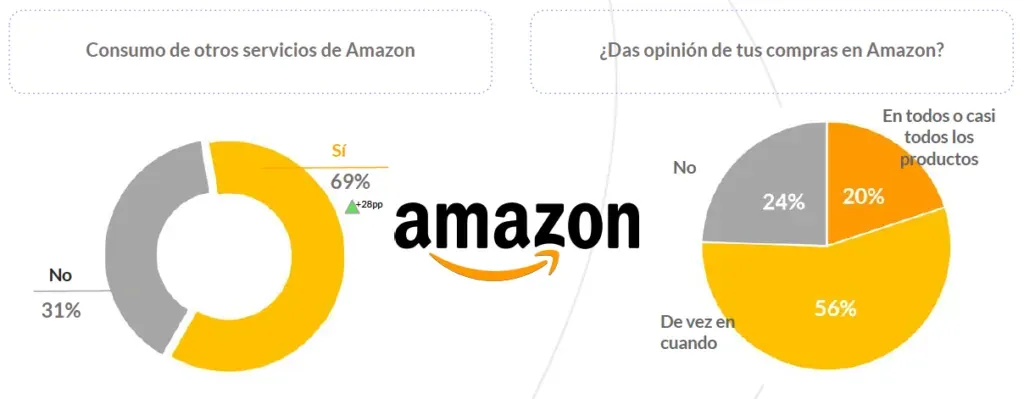
7 out of 10 use other Amazon services such as Prime Video or Music, and their opinion of the products is very high, at 76%.
7. The most striking conclusions:
- Competitive price, quality, and shipping costs are the 3 attributes of the ideal marketplace.
- From 18 to 70 years old, 72% of the population has bought on a marketplace, which means 100% of online shoppers.
- Average spend and purchase frequency are on the rise.
- Amazon is the top-of-mind marketplace, Carrefour has the highest average order value, and AliExpress is the one improving its results the most.
- Before the pandemic, 9 out of 10 were already buying on marketplaces.
- Growth in both awareness and purchases. Amazon leads the way, AliExpress has managed to gain ground, while Ebay has declined. El Corte Inglés has lost presence even within its core target.