
As a business or self-employed professional, chances are you’ve received a proforma invoice at some point, or that you need to create one yourself. Let’s look at what a proforma invoice is and how to fill one out.
Here’s what this blog will cover:
- What a proforma invoice is
- Factors to keep in mind
- When is it used?
- Essential elements
- Creating a proforma with Stockagile
- The difference between a proforma invoice and a quote
- The difference between a proforma invoice and a delivery note
1-What is a proforma invoice?
A proforma invoice has no commercial value; it simply contains the details of a future final invoice. We hand the proforma to the customer to outline an upcoming commercial transaction.
2-Factors to keep in mind
- It is not part of the company’s accounting records, nor is it declared for tax purposes.
- It is purely informational, so it is not an invoice to be collected from the customer.
- In the event of any dispute with the customer, the proforma invoice does carry legal weight and proves that there was activity between the two parties.
3-When is it used?
The proforma invoice is issued once the two parties have reached an agreement but haven’t yet formalized it. In many cases, the order has already been placed.
It is generally used in international trade involving customs, because:
- It is a sign of trust from the supplier to the customer regarding the commercial offer.
- It specifies the sale details and leaves room to modify them.
- It closes the legal gap when the goods haven’t arrived yet and the supplier hasn’t been paid — it’s a document that justifies that activity.
4- Essential elements
- Header clarifying that this is a proforma invoice.
- Issue date of the proforma invoice.
- Supplier identification, since the supplier is the one issuing the proforma invoice. Name, Tax Identification Number (NIF), address or registered tax domicile, intra-community VAT number, and contact details.
- Potential customer identification, including the same details as for the supplier.
- Detailed description of the products or services behind the invoice, including the unit price and the total cost — that is, factoring in shipping costs and any other additional charges.
- Applicable taxes which, once the final invoice is issued, you’ll have to record in your accounts and declare to Hacienda (the Spanish tax authority) during the tax self-assessment period set by the fiscal calendar.
5-Creating a proforma with Stockagile
With Stockagile it’s very easy to create proforma invoices. As we can see in these images, the fields that every proforma should include are:
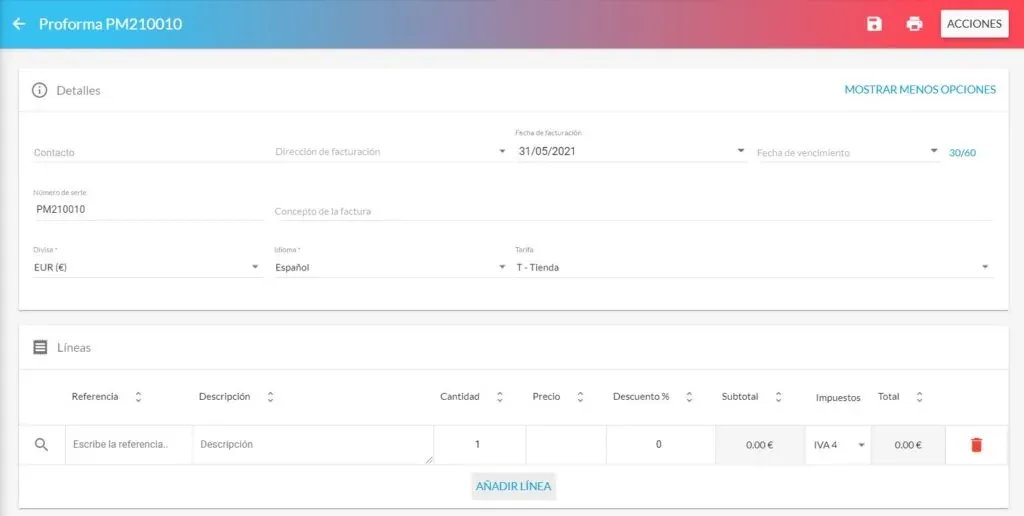
- The contact details: the customer’s name, the billing address, the invoice and due dates, the tax address, the serial number and the proforma reference.
- Additionally, we can add: the currency, the language and the price list (wholesale, outlet, etc.) the proforma invoice uses.
- The line items are the products (the order) we’ve agreed on with the customer. With Stockagile, those products are already created in the software.
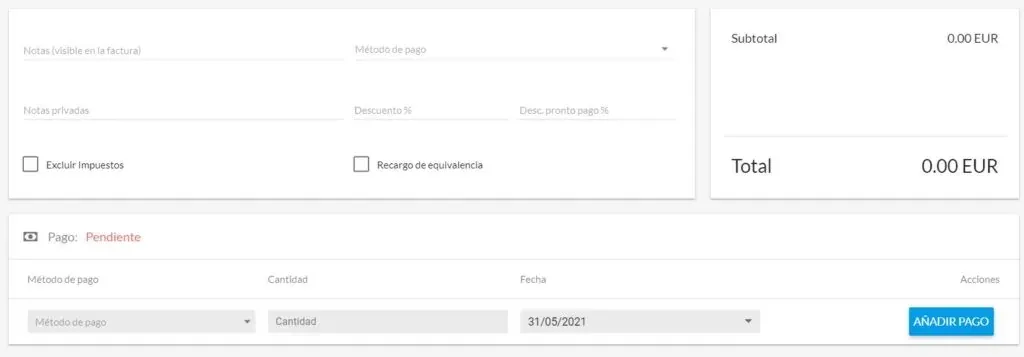
-
We’d have the option to add notes (private ones and ones shown on the invoice), the payment method, the discount (if any), and whether we want to exclude taxes or add the equivalence surcharge (recargo de equivalencia).
-
Finally, we have the payment information. We set the payment method, the amount and the date.
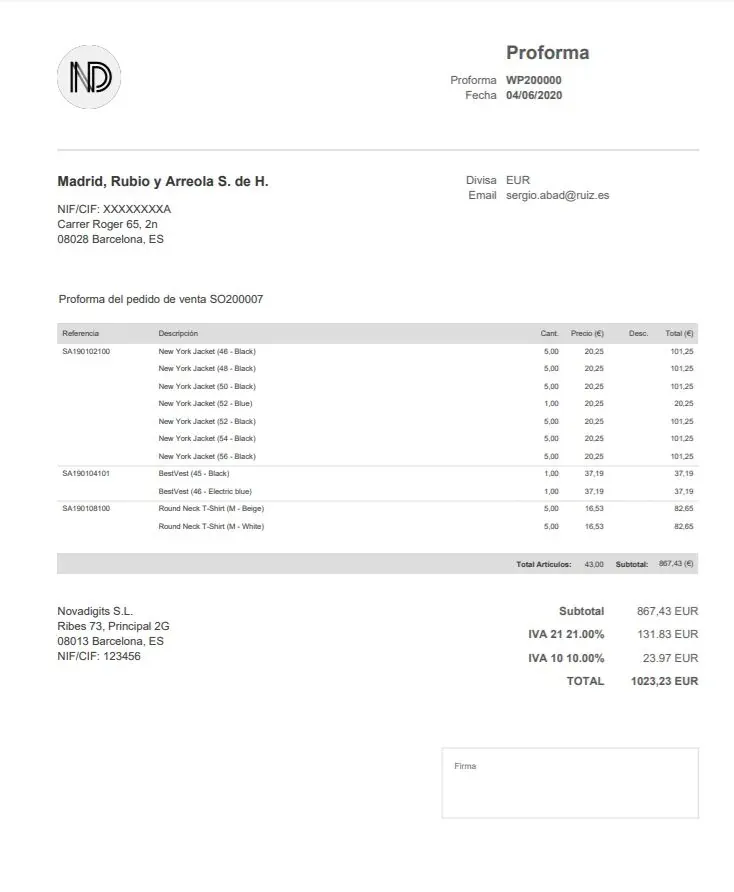
Once the proforma is configured, we can save it and print it as a PDF, as we can see in this example.
6-The difference between a proforma invoice and a quote
The difference between a quote and a proforma is often confused. A quote is a proposal from the supplier setting out the price and conditions of a final service or product for the customer. Typically, a quote involves more changes to the conditions and the transaction is more likely to fall through.
The proforma, on the other hand, shares the same definition as the quote, but there are far fewer changes to the agreement and it usually ends up being completed. There is more communication between the two parties and the conditions have been discussed at length.
Legally, the proforma carries legal weight and evidences that commercial activity took place between the parties, whereas the quote does not.
Normally, the negotiation process would begin with sending a quote; the conditions and price would then be finalized, and once agreed, a proforma would be sent.
7-The difference between a proforma invoice and a delivery note
The delivery note (albarán) is a document signed by the customer once the delivery has been completed. It is the proof of a goods delivery, guaranteeing that the product arrived. It has no accounting or tax validity.
The proforma, by contrast, is a provisional invoice for that commercial activity.