
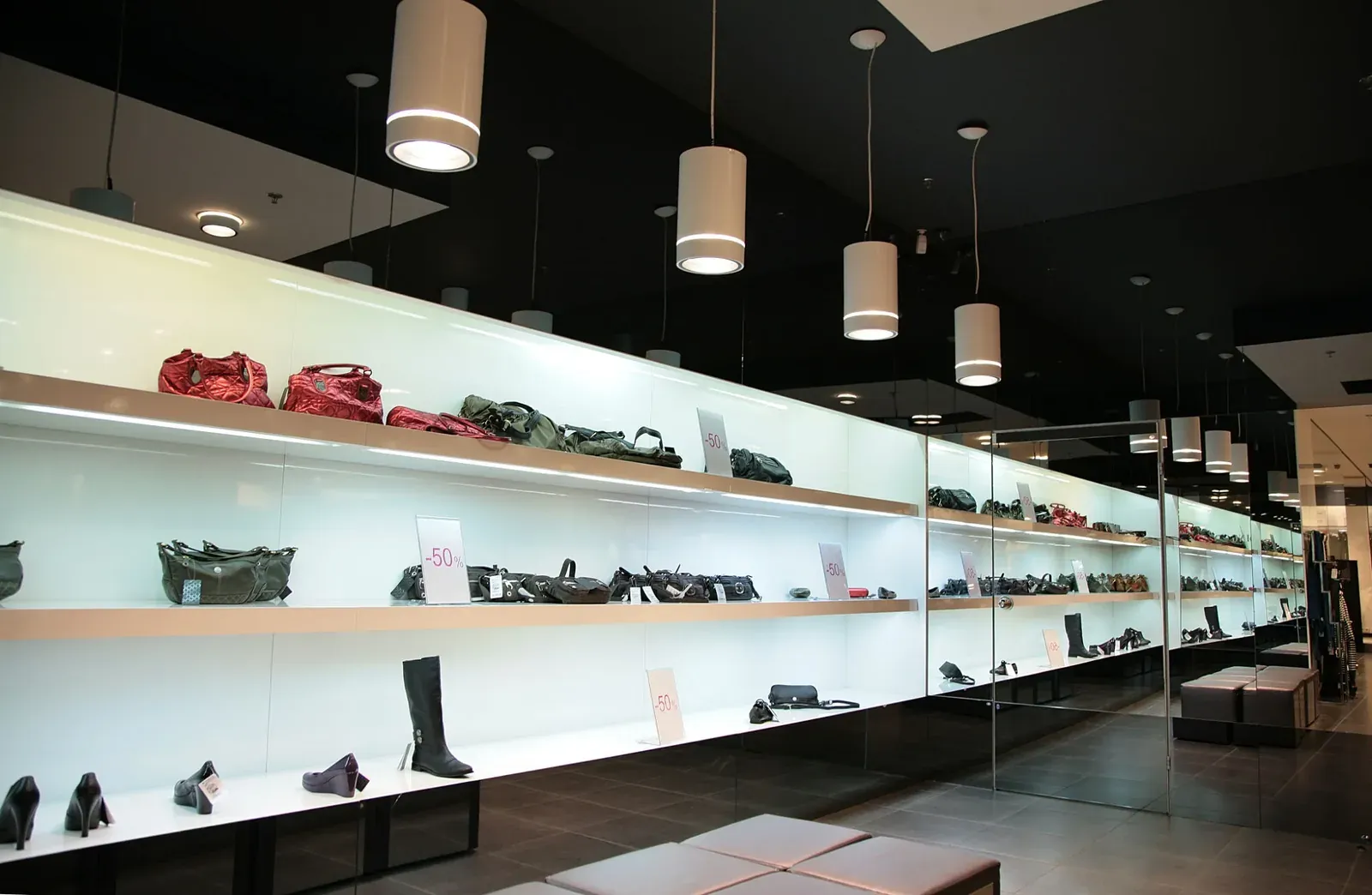
Lighting is a hugely important factor in a store’s atmosphere, because it lets us highlight exactly the sections we consider most important.
Choosing the light fixtures best suited to a retail space calls for weighing up a series of factors, grouped according to how much influence each one has.
Why does it matter so much in a store?
Lighting a store matters first and foremost for its functionality: it has to show customers the product they are about to buy. Sunlight alone is not enough to light an entire space, let alone light it evenly.
Light is also part of the venue’s ambience, setting the right stage. Fixtures are part of the interior decor and contribute to the brand’s image.
1. Aspects to consider:
1.1 Architectural features of the space to be lit:
- The size of the fixture and how well it is proportioned to the dimensions of its surroundings,
- The furnishing plan
- The type and shape of the structures.
1.2 The role of the fixture within the decorative scheme:
- Fixtures that are part of the decorative scheme
- Fixtures that are independent of the decorative scheme
1.3 The fixture’s function:
- Fixtures used to properly distribute the luminous flux of the bulbs
- Purely decorative fixtures
1.4 The fixture’s ability to meet lighting and visual requirements:
- General distribution of luminous flux
- Direct, indirect or combined output
- Directed, diffuse or combined distribution
- Symmetry or asymmetry of the flux distribution
1.5 The fixture’s light output or efficiency:
- Choosing the right flux distribution
- Loss of luminous flux
- Retention of luminous flux within the fixture
- Suitable, quality optical elements
1.6 Ease of maintenance:
- Level of environmental contamination
- Ease of cleaning
- Ease of changing bulbs
- Mechanical and thermal resistance
- Whether components can be replaced
2. The effects of light on materials and products
2.1 Lighting is a fundamental element in any store.
2.1.1 The different effects of light help improve the visibility of the products on display, as well as create atmospheres, decorate and make the items on show more appealing. Above all, lighting aims to make the product on display clearly visible.
2.1.2 Making good use of the different lighting effects on materials and products can make them look far more attractive.
On top of that, the intensity and color direction of the lights, together with the way shadows are shaped, create moods and turn an ordinary space into a magical scene. With smart lighting, some areas are dimmed while others are brought to the fore.
3. Types of light:
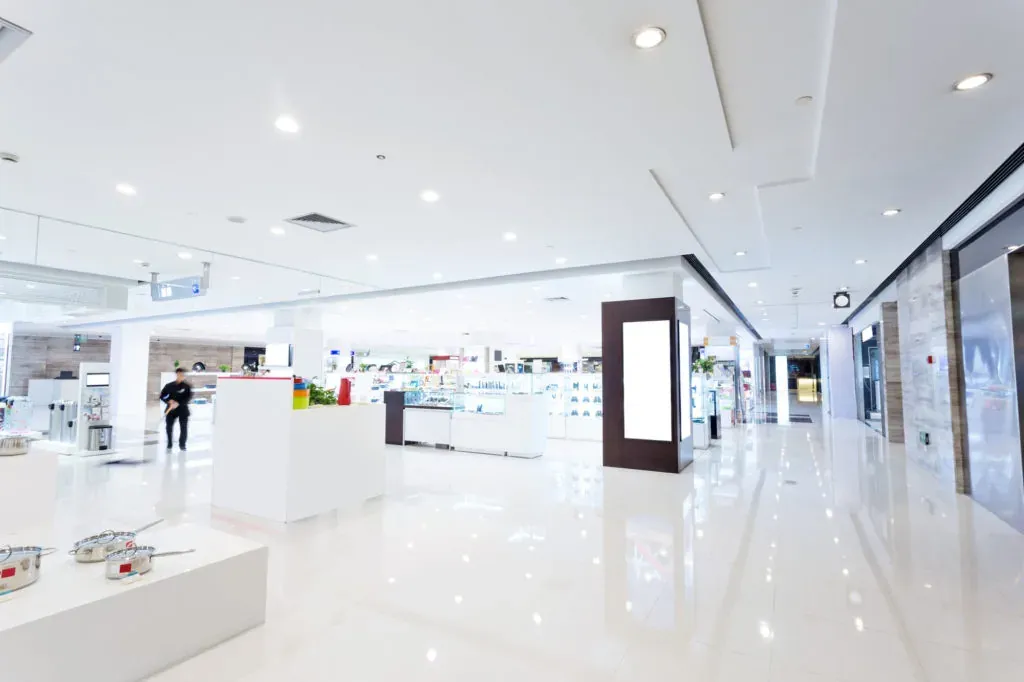
3.1 Natural light: lighting with natural light is defined as using direct, diffuse or reflected sunlight to provide full or supplementary illumination inside buildings.
As the saying goes, “daylight is the essential element that transforms conventional rooms into splendid spaces, adding value and quality to our homes and our lives.”
Lighting with natural light brings some very significant benefits, among them:
- A better view: natural light can help customers enjoy and see the space better.
- A more open feel: although windows do not actually create more space, they make rooms look larger, giving the illusion of more area.
- Lower energy bills: because sunlight warms the space naturally, the more of it you have, the less you will need to use fixtures during the day.
- More smiles: natural sunlight has been shown to lift people’s mood, improve their emotions and bring out more smiles, which in turn means more and better sales, as well as happier, more satisfied customers.
3.2 Halogen light
This is a warm, orange-toned light that gives off residual heat while it operates, which can be a drawback for certain applications. Halogen light is a very “concentrated” type of light, which is why it is usually used as accent lighting, to highlight specific objects or similar.
Its power consumption is constant, making it ideal for spaces where lights are switched on and off frequently.
3.3 Metal halide
This is a very bright light with a medium color temperature, which is its main advantage: it faithfully reproduces the natural colors of the objects it illuminates. Depending on the lamp or fixture, you can achieve tighter angles for the beam of light, which is otherwise quite wide.
3.4 Fluorescent
Low-consumption light, though of limited output. There are different color temperatures available (warm to cool) depending on the intended use. It gives off little residual heat, and most of its power draw happens at startup, dropping off afterward during operation.
3.5 LED lighting
Within the science of lighting, one of the technologies setting the trend is LED. These bulbs and accessories have been becoming mainstream for several years now. At first, however, they were more expensive than the usual energy-saving options.
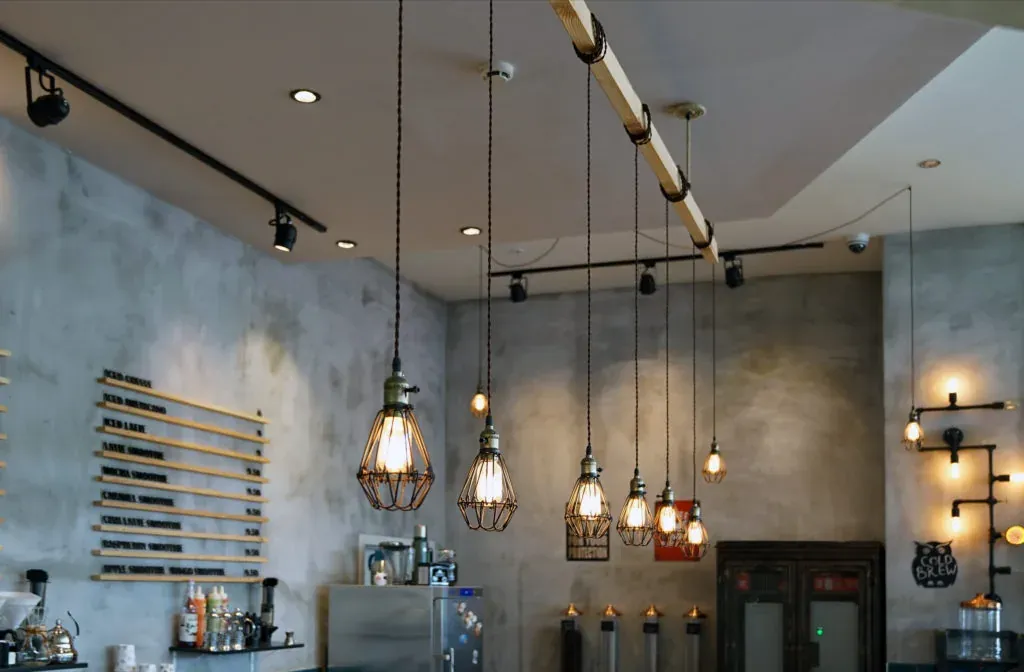
4. Lighting systems
4.1 Light is essential for bringing order and unity to any composition; it defines spatial orientation and clarifies structural challenges when it comes to light and shadow.
We can normally single out two lighting systems:
-
Main or direct light: this is the primary source, based on fixed lights aimed at the space. It is what determines the shape of the object and defines its shadow. In the first case, that is, with overhead lighting, short, hard shadows are produced.
-
Secondary light: this complements the main light. It is used to refine and soften the object, its shadow and the space. It also serves to tone down the main light when it is too strong. It is very useful for achieving better effects of depth, harmony and composition. In the second case, meanwhile, highly distorted shapes are produced that tend to rise toward the ceiling.
4.2 Let’s take a detailed look at the options for orienting light according to the angle at which it hits the illuminated object:
- Frontal overhead: lights the object from above, higher than the observer’s line of sight. This produces hard shadows, so it does not enhance detail but it does emphasize the object’s symmetry.
- Frontal overhead at 45º: lights the object from above, at a 45º angle above the observer’s line of sight. It closely resembles the natural lighting of sunlight; it is very natural and has always been used.
- Underneath: the object is lit from below, beneath the observer’s line of sight.
- Side: lights the object from one of its sides and is usually used at the same height as the observer’s line of sight, though placing it a little higher gives a more natural effect. It should be paired with additional lighting to soften the projected shadows. It is very effective for highlighting textures.
- Backlight: lights the object from behind, opposite the observer’s line of sight. It is risky, because it can dazzle the observer as well as leave the object in shadow. It is used above all to light translucent and transparent objects, while making sure the light does not shine into the observer’s eyes.