

Covid-19 has sparked a wave of creativity, pushing many businesses to reinvent themselves and look for alternatives to offset the losses caused by the crisis.
It’s a fresh opportunity to launch your first e-commerce store, one where the service doesn’t have to be entirely online. It gives you the chance to stay close to your customer and hand over the product in person.
Here’s what this blog will cover:
- What is it?
- Key benefits for the business
- Key benefits for the customer
- Which payment methods are used?
- How to implement Click and Collect?
- Examples from major companies
What is it?
Click and Collect, or buy online and pick up in store, is a purchasing model that blends e-commerce with traditional in-store shopping.
Its model is based on buying and paying online through an e-commerce store, while the product is picked up at the shop or a collection point close to the buyer, so they can conveniently stop by at a time of their choosing to grab their order.
This purchasing model offers a range of benefits for both businesses and shoppers.
Key benefits for the business:
- Minimize returns
- Cut operating costs, since the expense of running the service drops when you offer an alternative
- Keep sales strong and drive upselling, as being in the store can spark more impulse purchases
- Fast availability
- Better stock control
- Reach a larger number of customers
- Flexibility in planning deliveries
Key benefits for the customer
- Shipping costs are avoided when the customer picks up the order in store themselves
- Waiting times are much shorter
- It offers freedom over when to collect the product
- It avoids contact between the courier and the customer
- It streamlines the buying and collection process
- There’s no risk of receiving a damaged product
Which payment methods are used?
Payment is made online and the product is sent to the nearest warehouse, so customers pick up their order without needing to pay in store.
There’s also the option of in-store Click and Collect, where the customer reserves the product online and pays at the moment they collect the order.
On the other hand, Return in Store lets customers return damaged or unwanted products at the same shop.
How to implement Click and Collect?
To roll it out the right way
It can be set up from your own online store. Enabling this option in an e-commerce store is possible with apps like Shopify or WooCommerce or an extension, and it’s built into the order process.
It’s also possible on a marketplace like Zalando or Amazon, though it’s still a bit more
Examples from major companies:
DECATHLON
Decathlon offers up to 3 forms of Click and Collect: Click & Collect and Click & Car, the difference being that with the latter you have no contact with the salesperson, since you pick up your order without ever leaving your car.
IKEA
It’s a clear example of Click and Collect: you buy through their website and pay, and to pick up your order you choose the store you want, available after 3 hours have passed.
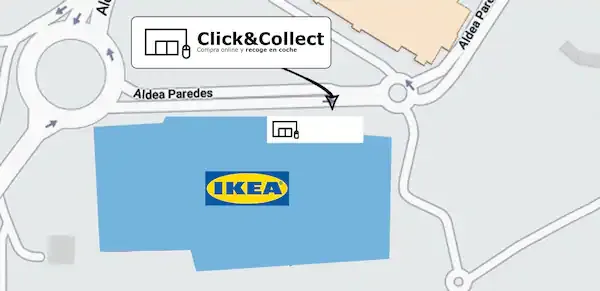
To accelerate this strategy, good planning is essential, from managing product management and availability to clear, timely communication that spells out exactly where the collection zone is.
Digital transformation, especially in these new times, has given rise to new retail strategies. Click and Collect delivers a complete, multichannel shopping experience.