
One of the main questions new freelancers have is how to work out the VAT that runs between their purchase invoices and their sales invoices, so we’re going to show you how to measure it.
Form 303 (Modelo 303) is the quarterly Value Added Tax (VAT, or IVA in Spain) return. It consists of the fractional VAT payment that must be paid to the Spanish Tax Agency (Hacienda).
What is it?
It is the difference between the output VAT charged on your sales invoices, that is, what you sell to your customers, and the input VAT borne on your expense invoices.
Who has to file it?
Every professional or business owner who carries out an activity subject to VAT must file Form 303. This VAT self-assessment must be filed quarterly, regardless of whether you are a freelancer, a company, a cooperative, and so on.
How do you calculate the VAT on a product?
One of the most common questions among freelancers and entrepreneurs is which VAT rate applies to a product or service, and this depends mainly on the economic activity being taxed.
VAT rate: 4% super-reduced – 10% reduced – 21% standard
How do you calculate the VAT on Form 303 and what is the formula?
It is recommended to complete the form through the Electronic Office of the Spanish Tax Agency, which will be submitted to the Tax Agency or to collaborating entities.
When gathering your sales and expense invoices, you need to extract the following data to enter it in the output VAT and input VAT sections of Form 303.
- Taxable base, amount.
- VAT rate applied.
- The tax due or final VAT amount you have collected or paid.
The calculation process for the settlement reflects the Value Added Tax your customers have paid on the sale of your products or services, and the VAT you have already paid as a customer to your suppliers, which you have to deduct.
Once you know the rate you need to apply, the formula for working out the cost of the product or service with VAT included is very simple:
Gross invoice amount (taxable base) x The VAT rate that applies to you (4, 10 and 21%)
Is it always quarterly?
No, there are certain cases in which the period will be monthly.
- Large companies with a turnover of more than €6 million in the previous year
- Business owners registered in the monthly refund register
As it is a tax that is split quarterly, it is settled in installments according to the dates of the tax calendar.
When can I file the return?
-
Quarterly / monthly returns: filings run from the 1st to the 20th of the month following the settlement period for the corresponding quarter, while monthly ones are due on the 30th of each month. The one corresponding to July can be filed in September. Due dates that fall on a Saturday or a non-working day are considered moved to the first working day.
-
Last quarter / month return: from the 1st to the 30th of January
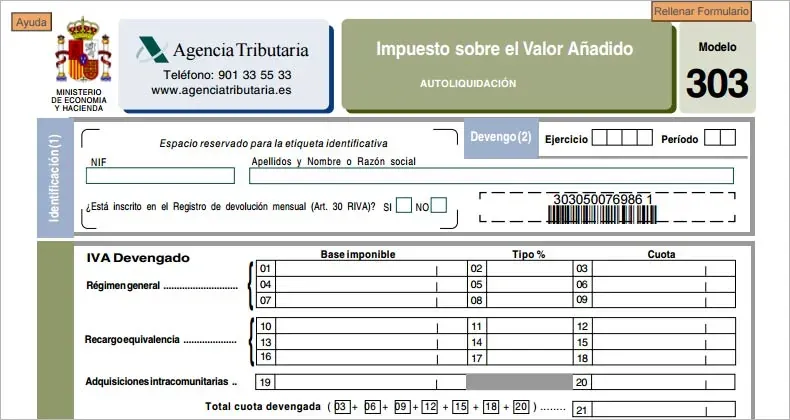
Completing Form 303
Sections 1 and 2 are Identification and Accrual. You must enter your name and surname or company name, tax ID (DNI), tax year and period.
Then there is a series of questions about the activities you carry out related to taxation and so on, which must be answered with yes or no.
Section 3 is the settlement section, where the output VAT collected from customers is detailed, along with the input VAT, meaning what has been paid to suppliers.
More answers…
-If there is no economic activity, you must still file Form 303 even if there is nothing to report.
-When the result is negative and it is the last quarter, you must request that the Tax Agency refund the amount to you.
– If the result is positive, you must provide the account from which the Tax Agency will collect the VAT.
If you want to learn more about Value Added Tax, the applicable rate and its operations, here we leave you a link with relevant information about the tax.