
Retail marketing covers every activity aimed at promoting and selling products to end consumers. From advertising and promotions to how products are laid out in the store and the overall customer experience. In essence, retail marketing strategies are about optimizing every customer touchpoint to maximize sales and loyalty.
Why does retail marketing matter for your business?
A well-executed retail marketing strategy can make a huge difference in a store’s performance. Here’s how marketing can impact your business:
It increases sales opportunities
Effective marketing strategies attract more customers and encourage additional purchases. A “buy one, get one free” promotion can bring your customers back to buy a newly launched product.
It turns occasional shoppers into loyal customers
A great shopping experience helps build customer loyalty and shapes a better perception of your brand. Points-based reward programs, store credit, and discount codes—paired with excellent customer service—are crucial to an effective retail marketing strategy. If your POS doesn’t offer loyalty programs, you can try Stockagile for free.
It sets you apart in a highly competitive market
Standing out in a saturated market isn’t easy. Stores that offer unique experiences—such as exclusive events, pre-sales, or product launches—differentiate themselves from their competitors.
The most effective retail strategies
Marketing evolves hand in hand with new technologies and industry trends, which is why it’s important to stay up to date. That said, here are the best proven techniques used today:
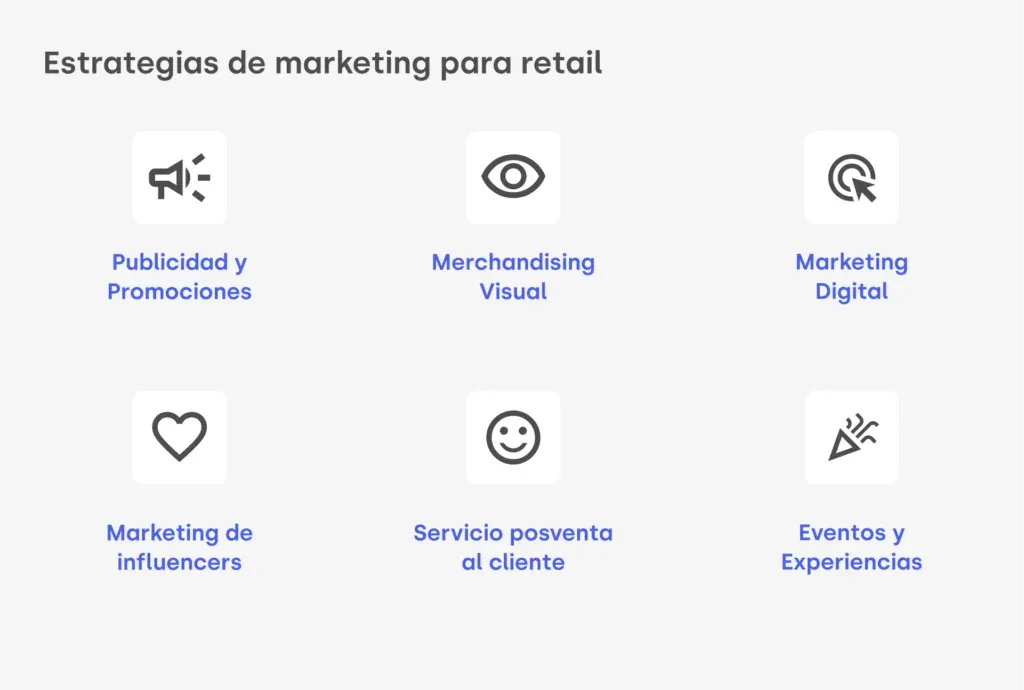
Advertising and Promotions
Offer discounts, run special sales and time-limited promotions. Sales during Black Friday, Cyber Monday, summer and winter sales, and back-to-office or back-to-school campaigns attract plenty of customers thanks to their seasonality and appealing discounts.
Visual Merchandising
Start with an eye-catching window display to grab the attention of passersby. Then, use the store’s interior design to immerse visitors in an enveloping experience. Finally, pay attention to the strategic placement of accessory products to encourage spontaneous purchases.
Digital Marketing
Social media is often the first point of contact users have with your products. That’s why it’s essential to present a polished image on platforms like Instagram, Facebook (Meta) and TikTok, using links that direct people to your online or physical points of sale. Advertising campaigns on these networks will not only boost the visibility of your clothing or products but also spark the interest of your target audience.
In addition, consider implementing email marketing strategies—offering newsletter subscriptions on your website and providing exclusive discount codes to subscribers. This will not only build customer loyalty but also encourage repeat purchases.
Integrating your CRM with your ERP is important so you can use your sales data to build segments for your campaigns. That’s why Stockagile integrates natively with tools like Mailchimp, which let you create automated email flows.
Influencer Marketing
A promotional retail marketing tactic that involves collaborating with influential people to effectively promote products, services, or brands. Today, most of these influencers come from the digital world, especially social media.
Excellent after-sales customer service
Once a sale is made, the work isn’t over. Exchanges, returns, questions, issues… customers need trained staff on hand who can quickly resolve their questions and problems after purchasing a product, in order to create a positive experience that brings them back to buy again.
Events and experiences
As mentioned earlier, hosting in-store events—such as product launches, demonstrations, and workshops—creates a stronger connection with customers. What’s more, these closer occasions are when you can gather insights from your potential customers to implement and fine-tune your marketing strategies.
How do I know if my retail marketing strategies are working for my business?
Sales Analysis
Monitor the increase in sales during and after your marketing campaigns to assess their impact. A significant rise can indicate the success of a promotional campaign. However, also account for any special circumstances or events that may have influenced sales, so you can isolate those factors from your analysis and get a more accurate evaluation.
Conversion Rate
Calculate the conversion rate from visitors to buyers to evaluate the effectiveness of your marketing tactics. A high conversion rate suggests your strategies are properly motivating visitors to make purchases. This indicator is crucial for understanding which elements of your campaign are working and which may need adjustments. For example, a high conversion rate may be the result of an effective advertising campaign, an improvement in the user experience on your website, or an irresistible promotion.
Customer Retention
Analyze purchase frequency and customer retention to evaluate the effectiveness of your loyalty programs. An increase in retention suggests that your efforts to keep existing customers are paying off. This analysis lets you identify patterns in customer behavior, such as how often they make repeat purchases or how they respond to promotions and rewards. A successful loyalty program not only increases retention but can also raise customer lifetime value.
Customer Feedback
Collect and analyze customer opinions and comments to gain valuable insights into their satisfaction and perception of your campaigns. This feedback is essential for identifying areas of improvement and adjusting your marketing strategies. Questions like “What did you like about your shopping experience?” or “What can we improve?” can provide deep insights. Actively listening to your customers and responding to their needs not only improves the customer experience but also strengthens long-term loyalty.
Digital Metrics
Use web analytics tools like Google Analytics or check the information provided by your website builder and social networks to measure the traffic, engagement, and conversions generated by your digital marketing efforts. Data such as email open rates, time spent on your website, and social media engagement are key indicators. These metrics let you see in real time how your campaigns are being received and give you the chance to quickly adjust your strategies. In addition, you can identify which channels are generating the highest return on investment.
Retail marketing is a powerful tool that can transform the shopping experience and significantly boost sales and customer loyalty. Implementing effective strategies and measuring their success is crucial for the sustainable growth of any retail business. Are you ready to take your retail marketing to the next level?
As Peter Drucker said, “The best way to predict the future is to create it.”
Now, more than ever, is the time to create the future of your retail business.
Frequently asked questions
What is retail marketing and why is it important for stores?
Retail marketing is the set of strategies and tactics that stores and shops use to attract and retain customers, increase sales, and improve the shopping experience. It’s important because:
It boosts visibility: It helps the store stand out in a competitive market.
It fosters customer loyalty: Through promotions and loyalty programs, customer retention increases.
It increases sales: Effective marketing strategies can attract more customers and motivate them to make purchases.
It improves the shopping experience: It provides a more pleasant and personalized shopping experience, which can improve customer satisfaction.
What are the most effective retail marketing strategies?
The most effective retail marketing strategies include:
Promotions and discounts: Offering discounts, special sales, and time-limited promotions to attract customers.
Visual merchandising: Using store layout, product placement, and window displays to draw customers in and encourage impulse purchases.
Loyalty programs: Implementing reward programs for frequent customers, incentivizing repeat purchases.
Digital marketing: Using social media, email marketing, and online advertising to reach a wider audience and drive traffic to the store.
Events and experiences: Hosting in-store events, such as product launches, demonstrations, and workshops, to attract customers and generate interest in the brand.
How can I measure the success of my retail marketing strategies?
To measure the success of your retail marketing strategies, consider the following methods:
Sales analysis: Monitor the increase in sales during and after marketing campaigns to assess their impact.
Conversion rate: Calculate the conversion rate from visitors to buyers to see how effective your tactics are at motivating purchases.
Customer retention: Analyze purchase frequency and customer retention to evaluate the effectiveness of your loyalty programs.
Customer feedback: Collect and analyze customer opinions and comments to gain insights into their satisfaction and the perception of your campaigns.
Digital metrics: Use web analytics and social media tools to measure the traffic, engagement, and conversions generated by your digital marketing efforts.