
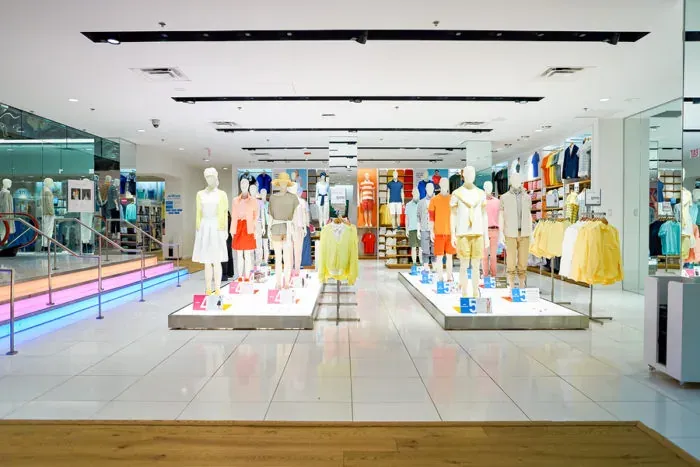
The itinerary is the path a customer follows inside a store, and it depends on the following factors:
- Entrance doors and checkout exits
- Information elements
- The layout of the fixtures
- The placement of the products
1. CHECKOUTS AND ENTRANCE DOOR
The position of the checkouts and entrance doors shapes the flow of movement within the point of sale.
- Attraction products are placed close to the first checkout. You can change this arrangement by removing the first checkout and door and placing these products along the back wall.
This produces a noticeable increase in sales, because customers who come to buy attraction products have to walk
a greater distance before they can make their purchases.
- In a self-service store, the position of the exit checkouts is dictated by the location of the entrance door. If the door is placed on the right of the premises, the checkouts will go on the left; conversely, if the door is placed on the left, the checkouts will go on the right.
Entrance on the right and checkouts on the left is the most commonly used layout in practice and the most advisable. The reasons behind this recommendation are influenced by research into the human tendency to head toward the back right.
Likewise, it seems proven that people push the shopping cart with their left hand and pick up products with their right. These considerations lead us to recommend that the entrance door be located on the right-hand side of the point of sale, leaving 25% of its surface area to the right of the door.
-
The peripheral movement of people in a counterclockwise direction also favors this placement of the entrance door if we want the customer to take a wider itinerary through the point of sale.
-
These are not the only layouts used in practice. We believe that, depending on the store’s offering and its clientele, there is a third possibility:
We are referring to placing the entrance door between the checkouts, leaving a variable number of them to the right and to the left. The idea behind these stores is to separate customers according to different sections and types of purchases.
Putting this strategy into practice requires laying out the store in a way that suits these considerations.
For example:
When the store can be accessed from different streets, it may be worth setting up two entrances with their corresponding exit checkouts, as long as the cost of this
measure is not too high.
2. Information elements
Another set of elements that influence the itinerary at a point of sale is made up of the various pieces of information that can guide customers inside the store.
Worth highlighting here are: signs, posters, store maps, panels, arrows and point-of-sale advertising.
We appreciate any information that lets us find our way easily and quickly (maps, booklets, brochures, arrows on the floor, information points, etc.).
This same situation plays out when we enter a point of sale and want to make the most of the time we have. The information elements that allow customers to orient themselves clearly within a store are therefore highly important from the standpoint of the image the point of sale conveys.
It is worth noting how little use is made of the store floor as a tool to guide customers along their route. Drawings or arrows on the floor are very useful for
directing customers so that they cover the entire store or easily find the sections they are looking for.
Store maps with information about the location of sections, products, checkouts, etc. are also
barely used. They would be extremely useful, especially in large stores, if handed out at the entrance to the point of sale, since actions like these enhance the store’s image.