
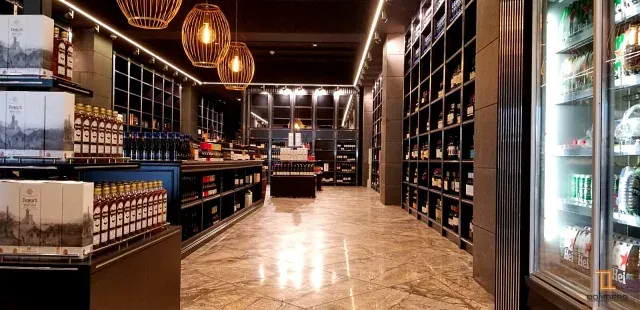
Aisles on a retail sales floor can be one of three types:
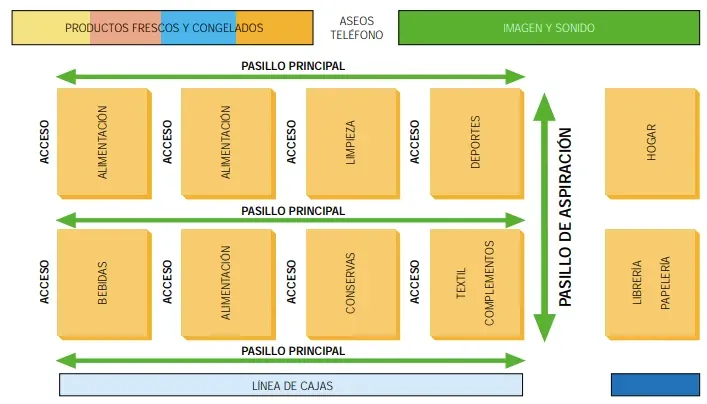
- Draw or aspiration aisle: This is the widest (between 5 and 10 meters across) and longest aisle in the store.
It runs in a straight line, connecting the entrance with the back of the store. Its purpose is to guide shoppers toward the deepest part of the establishment, relying on the positive psychological effect that wide, open spaces have on consumers.
It is usually the most attractive aisle, designed so that shoppers walk past as many meters of shelving as possible. It is mainly used by medium and large-format stores, given the dimensions required to lay it out.
- Main or central aisles: Essential in any retail store, their job is to orient shoppers inside the point of sale, making it easy to find and reach the different sections or departments.
They are usually long aisles to ease circulation. Their width tends to range between 2.5 and 5 meters, depending on the size of the store’s sales floor.
- Access aisles: These are the smallest aisles in the store in terms of both width and depth, yet they channel most of the foot traffic inside the point of sale.
They are laid out crosswise to the main or central aisles, allowing for two-way circulation. Their main purpose is to make shopping easier across the different sections.
Their width ranges between 1.80 and 3 meters. The width of the access aisle is normally taken as the reference for calculating the width of the rest of the aisles: it should be half that of the main aisle and a third that of the aspiration aisle.
To encourage customers to move through the store, aisles must be designed with that goal in mind. In addition, aisles should provide easy access to the various sections of the point of sale.
Wide aisles come with a few drawbacks:
- They reduce the amount of shelving space
- They make it impossible to see all the products on the gondolas the shopper walks between.
Narrow aisles, on the other hand, cause:
- Circulation problems
- Uncomfortable shopping during busy periods
We need to find a width that can be considered optimal, which depends on:
- The size of the store
- The section or type of product
- How the customer shops (by hand, with a basket, or with a shopping cart)
For self-service stores, the width of access aisles should reportedly range between 1.80 and 2.40 meters, that is, between the minimum needed for two carts to pass each other.
Large-format stores, however, can have access aisles up to 3.10 meters wide without any harm to their sales figures.
Another aspect to consider is aisle length. Empirical studies have shown a positive relationship between a greater aisle length and how shoppers perceive the products displayed on the shelves.
Longer aisles also have the advantage of forcing customers to follow a longer route. However, they come with the downside of making it harder to reach the different sections and complicating circulation inside the store.