
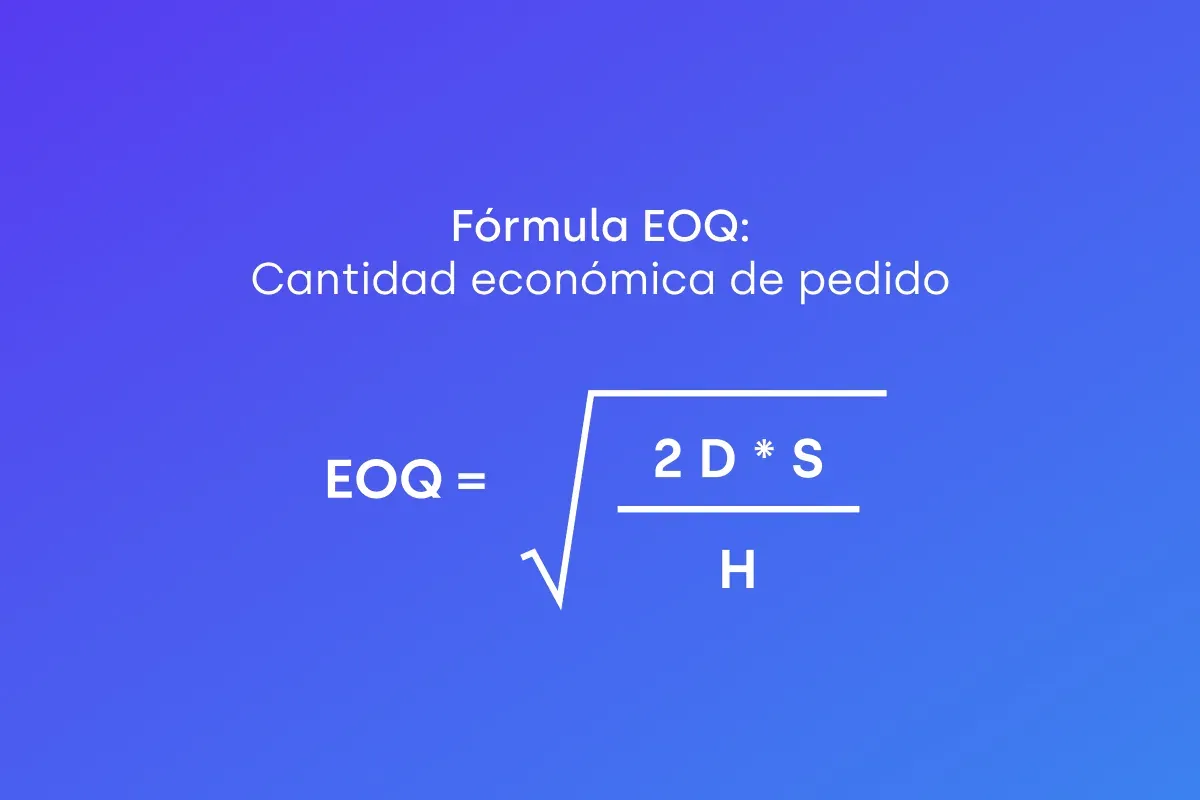
Easily work out how many units you should order from your manufacturer or wholesaler with the EOQ formula, or Economic Order Quantity:
(function() { var qs,j,q,s,d=document, gi=d.getElementById, ce=d.createElement, gt=d.getElementsByTagName, id=“calconic_”, b=“https://cdn.calconic.com/static/js/”; if(!gi.call(d,id)) { j=ce.call(d,“script”); j.id=id; j.type=“text/javascript”; j.async=true; j.dataset.calconic=true; j.src=b+“calconic.min.js”; q=gt.call(d,“script”)[0]; q.parentNode.insertBefore(j,q) } })();
If you’re looking for a way to optimize your retail purchasing and cut your costs, you’ve come to the right place! Want to know what this Economic Order Quantity thing is and how to apply its formula? Keep reading and discover how to do it in a few simple steps!
What is EOQ and why does it matter?
EOQ, or Economic Order Quantity, is a formula that helps you determine the optimal quantity of products you should order to minimize the costs associated with purchasing, storing and replenishing inventory.
Efficient inventory management is crucial in the retail business, since it lets you avoid problems like stockouts and overstock. Both can cause financial losses and hurt your store’s image. That’s why EOQ is a valuable tool that helps you make informed, profitable decisions.
The EOQ formula unveiled
The EOQ formula is based on three main variables:
- D: The annual demand for a product, in units.
- S: The cost of placing an order.
- H: The cost of holding one unit of product in inventory for a year.
The formula is as follows:

Now that you know the formula, it’s time to put it into practice. Let’s look at an example:
Practical example
Imagine you have a clothing store and you sell 2,000 t-shirts a year (D). The cost of placing an order with your supplier is €50, and the cost of keeping one t-shirt in stock for a year is €2 (H). Applying the EOQ formula:
In this case, the EOQ is approximately 316 t-shirts. This means that, to optimize your purchasing and reduce your costs, you should order 316 t-shirts each time you place an order with your supplier.

Additional considerations when applying the EOQ formula
While the EOQ formula is very useful, it’s important to keep certain aspects in mind before applying it in your business:
1. Demand stability
The EOQ formula assumes that demand for a product is constant throughout the year. However, if you experience significant fluctuations in demand due to seasons or specific events, you’ll need to adjust the formula or use other inventory management tools.
2. Volume discounts
In some cases, suppliers offer volume discounts when you buy large quantities of products. If that’s your situation, you’ll need to assess whether the savings from these discounts offset the additional costs of holding more inventory. If they do, it may be worth adjusting the EOQ to take advantage of them.
3. Lead times and availability
The EOQ formula doesn’t account for lead times and product availability. That’s why it’s important to make sure your supplier can meet the agreed deadlines and quantities, and to adapt the EOQ if there are supply restrictions or delays.
4. Storage capacity
Before applying the EOQ, evaluate whether your store has the space needed to store the recommended quantity of products. If not, you might consider adjusting the EOQ or looking into external storage options.
Benefits of applying the EOQ formula in your retail business
Applying the EOQ formula in your store can bring multiple benefits, such as:
- Cost reduction: By optimizing your purchasing and minimizing storage and replenishment costs, you’ll be able to increase your profit margins.
- Better inventory management: By keeping an optimal quantity of products, you’ll avoid problems like stockouts and overstock.
- Greater customer satisfaction: Keeping the right level of inventory lets you meet your customers’ demand in a timely, efficient way, which translates into a better shopping experience and stronger loyalty.
Conclusion
The EOQ formula is a powerful tool that will help you optimize your purchasing and improve the way you manage your retail store. Although it’s important to keep some considerations in mind when applying it, such as demand stability and storage capacity, overall it will help you make informed, profitable decisions in your business.
Remember that, while EOQ is an excellent starting point, there’s no one-size-fits-all solution for every store. That’s why we encourage you to evaluate and adjust this formula according to the specific needs of your business. This way, you’ll be able to maximize your profits and offer your customers an unforgettable shopping experience.
Now that you know the secret of the magic formula to optimize your retail purchasing, it’s time to put the EOQ formula into practice and take your business to the next level!