What is a product assortment?
A product assortment is the variety (not the quantity) of products we offer for sale in our business. To organize their product assortment, retailers follow a defined structure.
That is why a store’s assortment must have a Structure, Dimensions and Management geared toward the market segment it serves and the target customer it has.
This structure is built with the aim of making it easier for customers to find the product they are most interested in, allowing them to compare and classify each product beforehand. Where these products are placed plays a fundamental role in laying out the assortment.
Assortment characteristics
- Breadth. This refers to the different families that can be found within a single product assortment. If we carry a wide variety of products, we say the assortment has broad breadth; otherwise, the breadth is narrow.
- Depth. This depends on the number of products offered within each family. If we carry many products, we say our assortment is deep.
- Consistency. This term refers to whether the products complement one another — whether we need another product in order to use the one we were going to buy. That is why, for the most part, we find them placed close to each other.
- Degree of match. The assortment the store offers has to match what customers expect when they walk in — an important characteristic to keep in mind.
Product assortment structure
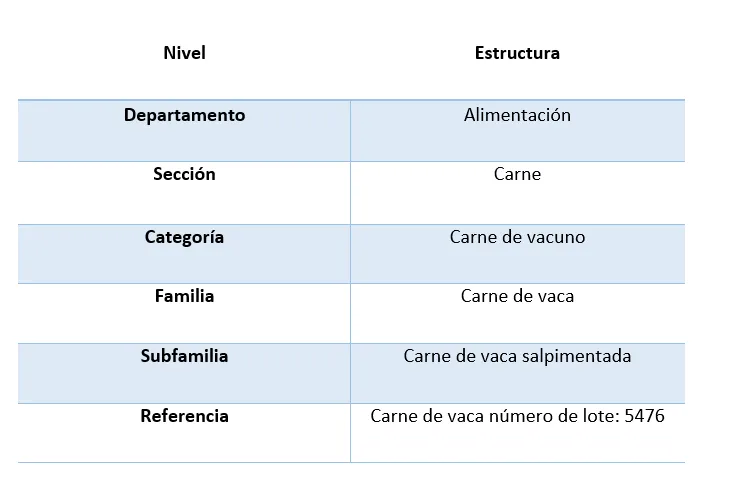
The structure has six different levels, whose purpose is to classify, identify and strategically manage the stock in our business.
- Departments: These are large groupings of products that complement one another or are homogeneous among themselves, while remaining independent from one another. This would be the case with a beauty, grocery or computing department, for example. They are found in large-format stores.
- Sections: These are independent units that you define and group into different categories or themes. For example, within food you have fruit, vegetables, meat, fish, and so on.
- Categories: These are divisions within a product section that bring together several families, forming groups of products that customers perceive as related in meeting a need. For example, in the perfumery section we find categories such as perfumes, colognes, facial cosmetics, and so on.
- By family: A set of products that answer the same generic need. It is an aspect within the category, so the consumer differentiates the product not by the need it satisfies but by some specific aspect. For example, mayonnaise (of various types), milks, and so on.
- By subfamily: These are subdivisions tied to a family and classified according to a criterion of use or appearance — such as shape, size, color, and so on. A good example would be bottled water: there is the 8-liter one and the liter-and-a-half one, to make it more convenient to use.
- By reference (SKU): These are sales units that satisfy the same specific need. They define the brand, format, model and content of the product.
How do I arrange my assortment?
Where we place our product assortment within the store is key to helping customers find what they want, to easing commercial and administrative management, and to locating items in the warehouse and on the shelves. Placing stock well in the store and in the warehouse guarantees an efficient organization in our business.
It is common to structure the assortment the way we saw above, but there are also retailers who choose to organize it according to various criteria:
- Similarity criterion: Manufacturing process, method of preservation, raw materials, ways of functioning.
- Origin criterion: same geographic area, same manufacturer or designer.
- Use criterion: Items aimed at the same group of consumers, satisfying the same consumer need.
- Differences criterion: Products that cannot be classified with any of the others, which we group together by their differences.
In the end, we will organize the product assortment in whatever way seems most coherent to us for the store. There is no single best way to structure it and no rule to follow — every business adapts to the needs of its customers.