

Demand forecasting is a cornerstone of both traditional and e-commerce businesses, shaping inventory management strategies, production planning and overall market responsiveness. This in-depth guide dives into the mechanics, methodologies and applications of demand forecasting, offering an enriched perspective that assimilates and goes beyond insights drawn from a range of sources.
Unraveling the complexity of demand forecasting
Demand forecasting is a sophisticated process that combines predictive analytics, market analysis and statistical modeling to anticipate future customer demand. Embedded within demand planning, this process is essential for aligning business operations with market dynamics, ensuring efficiency and optimizing resource allocation.
Types of demand forecasting: when and how to use them?
Demand forecasting can be broken down into several types, each of which addresses different business needs and scenarios:
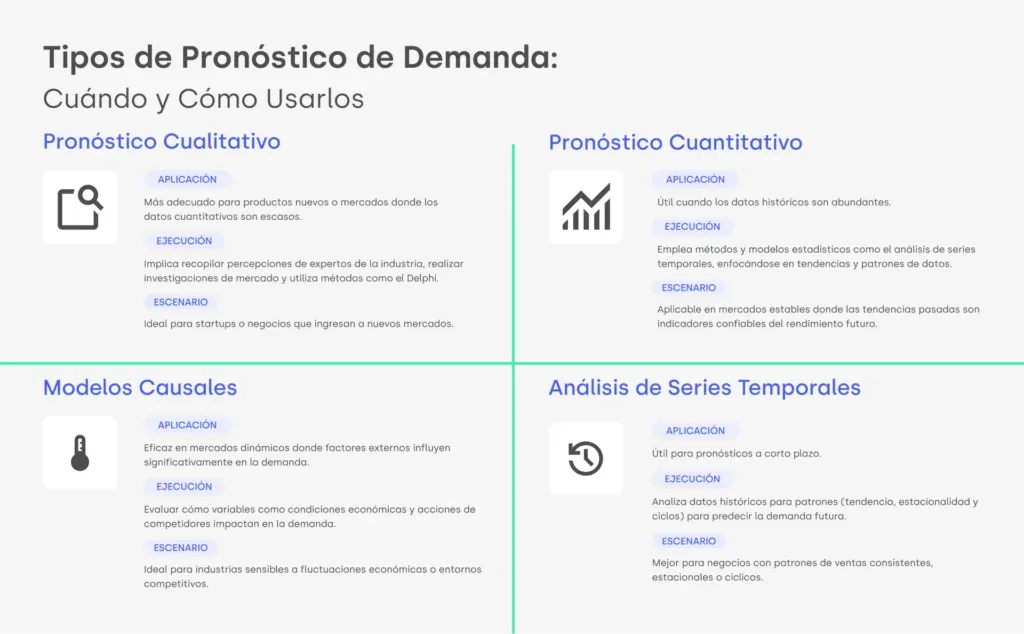
Qualitative forecasting:
- Application: Best suited to new products or markets where quantitative data is scarce.
- Execution: Involves gathering input from industry experts, conducting market research and using tools such as the Delphi method to consolidate expert opinions.
- Scenario: Ideal for startups, companies entering new markets or launching new products.
Quantitative forecasting:
- Application: Useful when historical data is plentiful.
- Execution: Uses statistical methods focused on data trends and patterns.
- Scenario: Applicable in stable markets where past trends are reliable indicators of future results.
Causal models:
- Application: Effective in dynamic markets where external factors significantly influence demand.
- Execution: Incorporates econometric models and regression analysis to assess how variables such as economic conditions and competitor actions affect demand.
- Scenario: Ideal for industries sensitive to economic fluctuations or the competitive landscape.
Time series analysis:
- Application: Useful for short-term forecasts.
- Execution: Analyzes historical data for patterns (trend, seasonality and cycles) to predict future demand.
- Scenario: Best for businesses with steady, seasonal or cyclical sales patterns.
Exploring the leading demand forecasting methodologies
Demand forecasting encompasses several methodologies, each offering unique insights and addressing different business needs. Understanding these methodologies is crucial for companies to accurately predict market demand and make informed decisions. Here we explore five foundational demand forecasting methodologies: trend projection, market research, sales force composite, the Delphi method and the econometric method.
Trend projection method
- Overview: Trend projection, a quantitative approach, involves analyzing historical sales data to identify patterns and project these trends into the future.
- Application: This method is especially effective in stable markets where past patterns are likely to hold.
- Process: It relies on statistical techniques such as moving averages or exponential smoothing, which smooth out anomalies in past data to reveal underlying trends.
- Ideal use case: Perfect for products or services with consistent sales patterns over time.
Market research method
- Overview: Market research is a qualitative approach that collects data directly from potential or current customers through surveys, interviews and focus groups.
- Application: It helps you understand customer preferences, behaviors and potential market shifts.
- Process: The data gathered is analyzed to identify customer needs, gauge market potential and predict future demand.
- Ideal use case: Especially useful for launching new products or entering new markets.
Sales force composite method
- Overview: This method involves collecting insights and predictions from the sales team, who are usually closer to customers and market trends.
- Application: Sales representatives provide their sales forecasts, which are then aggregated to form a company-wide forecast.
- Process: It leverages the sales team’s field experience and customer knowledge, making the forecast more grounded in market realities.
- Ideal use case: Effective in companies where the sales team has a strong understanding of customer needs and market conditions.
Delphi method
- Overview: The Delphi method is a structured communication method that relies on a panel of experts.
- Application: Experts respond to questionnaires over several rounds and, after each round, a facilitator provides a summary of the forecasts and the reasoning behind them.
- Process: The process continues until the panel reaches a consensus, ensuring that diverse opinions are considered and refined.
- Ideal use case: Useful in scenarios involving significant uncertainty or where expert opinion is highly valued.
Econometric method
- Overview: The econometric method is a quantitative approach that uses statistical models to forecast demand, taking multiple economic variables into account.
- Application: It involves building models that correlate demand with factors such as price, income levels, economic conditions and other relevant variables.
- Process: It uses regression analysis and other statistical techniques to understand how changes in economic factors affect demand.
- Ideal use case: Best suited to situations where demand is heavily influenced by economic factors and external market conditions.
The methodological path to effective demand forecasting
Successfully applying a demand forecasting strategy requires a systematic approach:
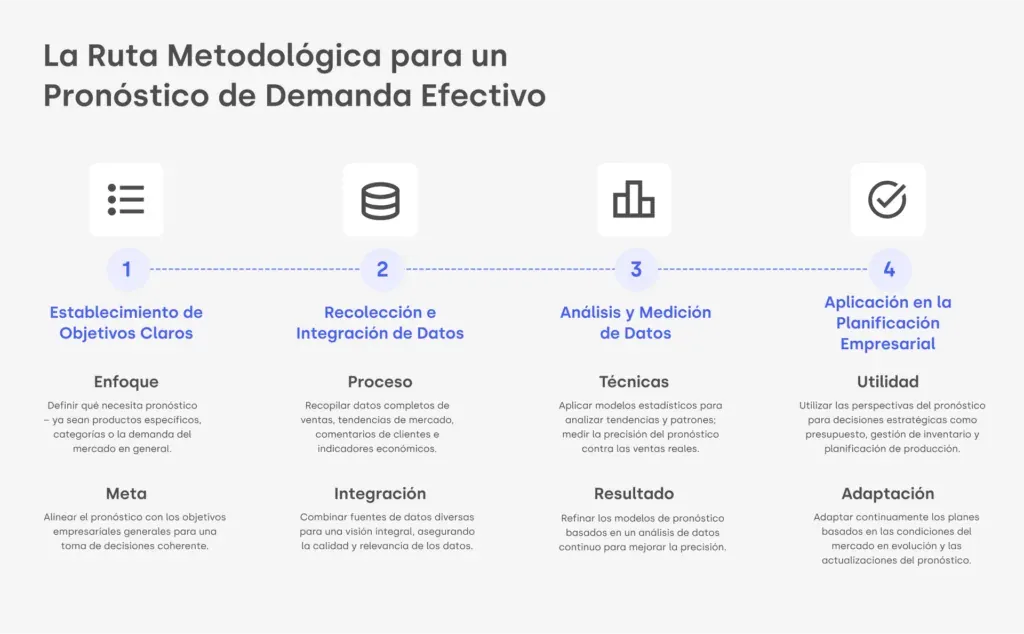
Set clear objectives:
- Focus: Define what needs forecasting, whether that’s specific products, categories or overall market demand.
- Goal: Align forecasts with broader business objectives for consistent decision-making.
Data collection and integration:
- Process: Gather comprehensive data on sales, market trends, customer feedback and economic indicators.
- Integration: Combine diverse data sources for a holistic view, ensuring data quality and relevance.
Data analysis and measurement:
- Techniques: Apply statistical models to analyze trends and patterns; measure forecast accuracy against actual sales.
- Outcomes: Refine forecasting models based on ongoing data analysis to improve accuracy.
Application in business planning:
- Use: Use forecasts to make strategic decisions such as budgeting, inventory management and production planning.
- Adaptation: Continuously adapt plans in response to evolving market conditions and forecast updates.
Leveraging technology to sharpen forecasts
Technological advances, especially in demand planning software, have revolutionized demand forecasting. These tools offer AI-driven insights, predictive models and data analysis capabilities, providing businesses with nuanced and accurate demand predictions.
Software such as Stockagile is the perfect choice for retail businesses.
The future trajectory of demand forecasting in retail
The future of demand forecasting promises further advances in technology and methodology, offering businesses greater opportunities for optimization and growth.
Demand forecasting is a strategic imperative in modern retail. Effective implementation can lead to optimized operations, reduced costs and increased customer satisfaction, giving businesses a significant competitive edge.
Frequently asked questions about demand forecasting
What factors should guide the choice of a demand forecasting type?
.
The choice depends on market dynamics, data availability, industry-specific factors and the nature of the products or services.
How do demand forecasting methodologies differ between traditional and e-commerce businesses?
While the core principles remain similar, e-commerce often demands greater real-time data integration and rapid adaptability due to the fast-paced nature of online markets.
Can small businesses apply demand forecasting effectively?
Yes, small businesses can leverage simpler demand forecasting models and technologies to improve their decision-making and operational efficiency.
What role do advanced technologies play in demand forecasting?
Technologies such as AI and machine learning provide deeper market insight, improve forecast accuracy and enable real-time data analysis.
How often should demand forecasting models be reviewed?
Regular review is crucial to adapt to market changes, and its frequency depends on how dynamic the industry is and on data availability.