
We’ve always assumed that taking products or services international was something only big companies did, not the typical retail business. But in the highly globalized world we live in, we need to change that mindset.
Growing sales by expanding into new markets and avoiding a dependence on the domestic market both help secure a company’s long-term future.
Within international trade contracts you’ll find the Incoterms, a set of rules designed to reduce uncertainty between companies.
Here’s what this post covers:
- What are Incoterms and what are they for?
- What is an international trade contract for?
- The 11 types of Incoterms in sales contracts
- What factors should you weigh when choosing an Incoterm?
What are Incoterms and what are they for?
They are a set of international rules that define the commercial terms of an international sale and establish the rights and obligations of both buyer and seller.
Their goal is to reduce the uncertainty that comes from dealing with so many different laws, practices and customs.
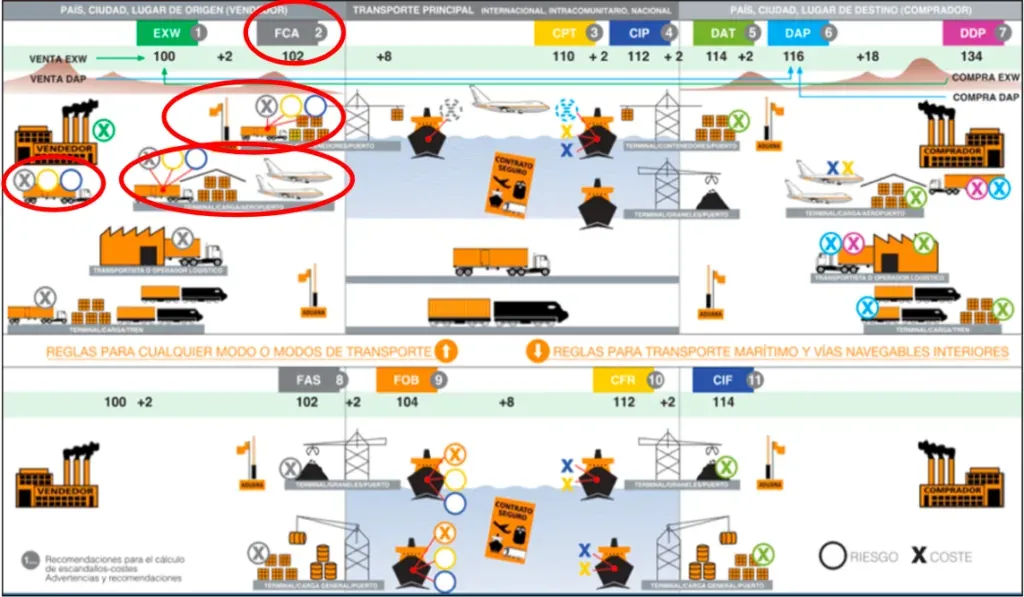
Incoterms regulate:
– Place of delivery
– Point at which risk transfers
– Distribution of transport costs – Documentation and customs
Incoterms do not regulate:
– Method of payment
– Applicable law
– Breaches and their consequences – Payment
What is an international trade contract for?
- It reduces the degree of uncertainty
- It builds greater trust
- If a problem arises, you’ll know who is responsible for the goods, transport and payment
- It discourages either party from taking advantage of the commercial relationship
- It projects an image of professionalism, commitment and experience
It doesn’t offer a total guarantee, but it does reduce uncertainty.
In the event of a dispute, a court will decide based on what was agreed and the applicable law. There can sometimes be exceptions, depending on commercial customs, general terms and conditions, trade practices or specific operations.
The 11 types of Incoterms in sales contracts
Category 1: Incoterm EXW – Ex Works
The seller delivers the goods at their own premises (or retail location), doesn’t load them onto the means of transport, but is responsible for packaging and labeling.
The buyer handles the export formalities, including transport, customs and so on.
*Possible issues with the seller’s tax authority (Hacienda) if they can’t prove the goods were sold abroad and the buyer doesn’t provide the necessary documents.
Category 2: Incoterms FCA, FAS, FOB
The seller delivers the goods at the agreed place of origin; the buyer pays for transport.
FCA – Free Carrier: the seller delivers the goods loaded onto the transport (any mode) and doesn’t cover handling costs at origin.
FOB – Free On Board: the seller delivers the goods on board the ship at origin and covers handling costs at origin (the carrier loads them onto the ship).
FAS – Free Alongside Ship: the seller delivers the goods alongside the ship at origin but doesn’t load them on board.
Category 3: Incoterms CFR, CIF, CPT, CIP
The seller has to arrange transport, whether or not they assume the risk. They pay the transport costs, but the goods become the buyer’s property once transport begins.
CPT – Carriage Paid To: the seller arranges transport but doesn’t assume the risk once they’ve handed the goods to the first carrier (any mode of transport).
CIP – Carriage and Insurance Paid: the seller arranges transport and also takes out insurance for whichever transport is used.
CFR – Cost and Freight: the seller arranges transport but doesn’t assume the risk once the goods are on board the sea vessel.
CIF – Cost, Insurance and Freight: the seller arranges transport and is required to take out insurance for the sea transport.
[](https://www.comercioyaduanas.com.mx/incoterms/incoterm/incoterms-2020/)
Category 4: Incoterms DDP, DAT, DAP
The seller has to bear all the costs and risks of getting the goods to the destination country.
DPU – Delivered at Place Unloaded: covers the costs and risks of all the formalities at origin, that is, packaging, loading, export clearance, freight, unloading at destination and delivery to the point previously agreed between the parties.
The buyer handles all the import clearance formalities.
DPU replaces the former DAT; the new twist is that the delivery options are broadened. Delivery can now take place at any agreed delivery point.
DAP – Delivered At Place: the seller delivers the goods at the agreed destination point (factory, terminal, etc.), doesn’t handle the customs formalities and DOES cover part of the port-handling costs at destination.
DDP – Delivered Duty Paid: the seller delivers the goods at the buyer’s premises, DOES handle the customs formalities, pays the duties and taxes and covers the handling costs at destination.
What factors should you weigh when choosing an Incoterm?
Mode of transport for going international:
FAS, FOB, CFR, CIF – use sea transport but can’t use a container; the goods are general cargo.
EXW, FCA, CPT, CIP, DAT, DDP – use multipurpose transport and containers.
(DAT and FAS for bulk cargo)
Size of the company
-
If your company/retail business is small or medium-sized and you’re selling to a large company (a multinational), you should normally sell with a “short” Incoterm: EXW, FCA, FOB, since the larger company will usually secure better freight rates and better insurance.
-
If your business/retail operation is bigger than the one you’re selling to, the Incoterm used should be “long”: CIP, DAT, DAP, since you’ll likely have better freight rates and better insurance than your customer.
The risk to assume
- Commercial
- Political
- Exchange-rate
- Interest-rate
- Logistical -> If you have no expertise here, it’s better to choose a “short” one (EXW, FCA, FOB) so the buyer takes control.
The nature of the destination country
For some countries you have to factor in: demographics, corruption, infrastructure, safety… = little logistical control
To reduce risk, the seller should use “short” Incoterms.
The method of payment:
The methods of payment are: bank transfer, banker’s draft, personal check, simple payment order, simple remittance, documentary remittance, documentary payment order and documentary credit, whether revocable or not.
Legal protection
Choosing one Incoterm over another entails obligations that, in the event of a conflict, will be assessed by judges or arbitrators.
Incoterms optimize and minimize the costs of the operation.
StockAgile recommends using Incoterms with the help of a transport company that specializes in this kind of operation, in order to minimize the risks that improper use poses for a retail business.