
Are you an entrepreneur looking to build your own business? At StockAgile we show you how to create a Business Model Canvas to shape your business model.
The BMC is a tool for analyzing, designing and creating business models, bringing together different hypotheses about your business idea. It complements the traditional business plan, and its goal is to create, develop and capture value.
Its main advantages are:
- Flexible
- Visual
- Big-picture view of the organization
- Easy to understand
- Co-creation
- Prototyping
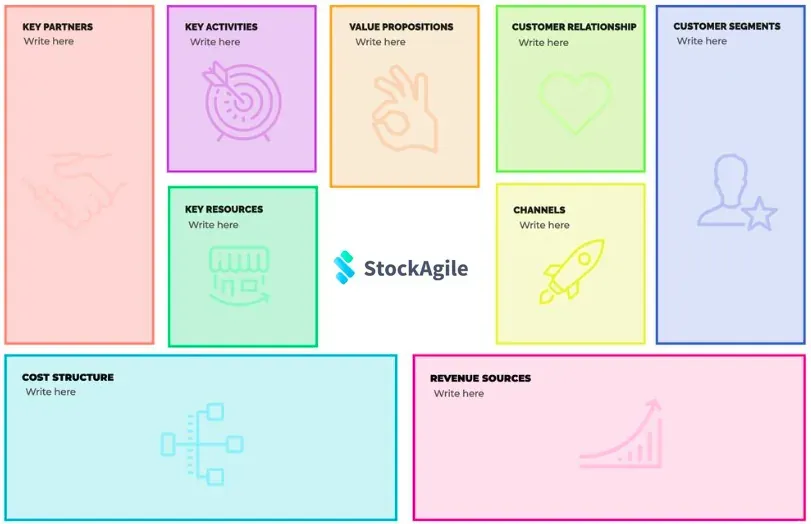
To make each step of the Business Model Canvas easier to grasp, we’ll walk through different examples within each block, focused on the retail store.
One example would be a retail clothing store selling directly to consumers.
1. Customer Segments
This is where you list the different groups of people or organizations for which your business model creates value.
Types of Customer Segments:
– Mass market
– Niche market
– Segmented market
– Diversified market
– Multi-sided markets
Clothing retail: aged between 25 and 50, high socioeconomic level, embracing digital commerce, looking for products for major events.
2. Value Propositions
The customer needs or problems you solve through your value proposition. It’s what sets you apart from the competition and what your customer is willing to pay you for.
Some types of value proposition:
- Newness
- Performance improvement
- Customization
- Design
- Brand and status
- Price
- Cost reduction
- Risk reduction
- Accessibility
- Convenience/usability
Clothing retail: tailored customer service and exclusive products.
3. Channels
How the company communicates with its different market segments to reach them and deliver its value proposition.
Some types of channels:
- Sales force (sales team) / Web
- Own stores
- Partner stores
- Wholesale
Channel phases:
- Awareness
- Evaluation
- Purchase
- Delivery
- Evaluation
- After-sales
Clothing retail: the company communicates through Instagram and email.
4. Customer Relationships
In this module of the Business Model Canvas we capture the different types of relationship we maintain with our customers. We can have a different relationship for each customer segment.
Types of customer relationships:
- Personal assistance
- Dedicated personal assistance
- Self-service
- Automated services
- Communities
- Co-creation
Clothing retail: building trust and confidence with the customer, and offering financing so customers can pay for the clothes they buy in installments.
5. Revenue Streams
The cash flow the company will generate from each customer segment. That said, your business and model will likely evolve and these could change.
Possible revenue streams:
- Asset sales
- Usage fees
- Subscription fees
- Lending/renting/leasing
- Licensing
- Brokerage fees
- Advertising
Clothing retail: the monthly payments from customers with financed products, plus online and in-store sales.
6. Key Resources
The most important assets required to make a business work. Greater or fewer resources will call for greater or smaller financial and intellectual efforts, third-party agreements, and so on.
Some types:
- Physical
- Intellectual
- Human
- Financial
Clothing retail: whether the company will need its own warehouse, customer databases and an expert sales team.
A key resource for many retailers is the StockAgile software, created to digitalize and professionalize small and medium-sized brands, wholesale businesses and stores.
It’s built to digitalize processes and make the most of retailers’ resources, letting them manage their channels in an automated way.
7. Key Activities
The most important actions a company must take to create and deliver value and make its business work. Some types:
- Production
- Problem solving
- Web platform
- …
Clothing retail: a stylist up to date with the latest fashion, studying the competition’s offers, and maintaining the eCommerce store.
8. Key Partners
In this module we place the network of suppliers and partners that make the business model work.
Reasons to form alliances:
- Optimization and economies of scale
- Reduction of risk and uncertainty
- Acquisition of resources and activities
Sometimes we might place someone in this module as a partner when they should actually appear in the customers module.
Clothing retail: the manufacturers that supply the clothing, stylists, models, delivery agents, etc.
9. Cost Structure
The costs needed to create and deliver the value proposition and thereby generate revenue. Companies sometimes base their model on costs, others on value.
Some types of cost structure:
- Fixed costs
- Variable costs
- Economies of scale
Clothing retail: employee salaries, taxes and expenses.
With these 9 columns you’ll be able to build a business model grounded in who the customer is, their need or problem, and what the value proposition will be.
At StockAgile we place great importance on retail and its digitalization, which is why we want to give you more information about the POS system and its huge importance in this new era.