

In this article, we’re going to walk you through the four stages that make up a product’s life cycle, how to identify which stage a product is in, and which marketing strategies are most appropriate for each one.
This way, you’ll be able to better understand how your product behaves in the market, adapt your marketing strategies to each stage of the life cycle, and get better results.
What is a product life cycle?
Have you ever wondered why some products become sales phenomena while others come and go without a trace? The answer lies in how a company manages each stage of every product’s life cycle.
A product’s life cycle is the natural process a product goes through, from its launch in the market to its eventual disappearance.
The 4 stages of a product’s life cycle
Broadly speaking, a product goes through 4 stages: introduction, growth, maturity and decline.
- Introduction
Introduction is the first stage of the product life cycle. During this stage, the product is launched into the market and the goal is to capture the attention of the target audience, since consumers aren’t yet familiar with it and demand is low.
During this first phase, the product’s price is likely to be high due to production and distribution costs. Companies will need to invest in advertising and promotion to make the product known and generate consumer interest.
[Read marketing strategies for the introduction stage](#Estrategias introducción)
- Growth
During the growth stage, the product starts to gain popularity and there is an increase in sales and profits. However, this stage also brings a rise in the number of competitors in the market. It’s therefore a critical moment where you need to focus on promoting and improving the product in order to keep growing.
It’s important to implement strategies that help the product stand out and consolidate the brand’s image in the market.
[Read marketing strategies for the growth stage](#Estrategias crecimiento)
- Maturity
The maturity stage is the longest in the product life cycle and is characterized by a slowdown in sales growth.
During this period, demand begins to stabilize and competitors are well established. The product’s price may fall even further, and companies will need to focus on maintaining customer loyalty and improving product quality to hold their position in the market.
[Read marketing strategies for the maturity stage](#Estrategias madurez)
- Decline
The decline stage is the period in which the product starts to lose popularity and sales. In this stage, demand drops and the strongest competitors gradually push the product out of the market. During this phase, important decisions must be made, such as whether to keep investing or to withdraw the product from the market.
[Read marketing strategies for the decline stage](#Estrategias declive)
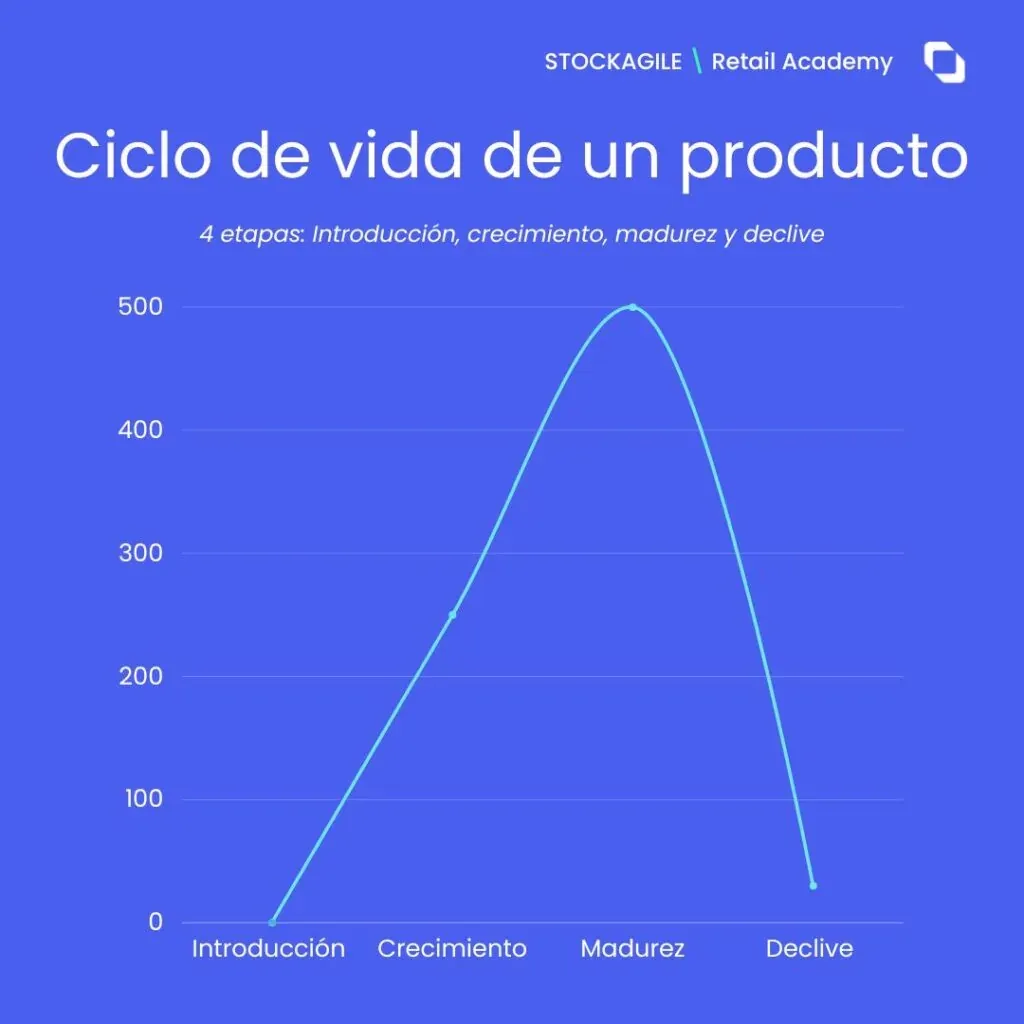
It’s worth noting that not every product goes through all the stages of the life cycle. Some products may have a short life and never reach the maturity stage, while others may have a long life and remain in the maturity stage for many years.
It’s also possible for a product to return to the introduction or growth stage by implementing new marketing strategies, such as launching a new version of the product or expanding into new markets.
How to identify which life cycle stage a product is in: 3 tips
Knowing how to recognize which stage a product is in matters because it lets you make better decisions about how to focus your marketing and development strategies.
Otherwise, you could be missing growth opportunities or even putting your business’s profitability at risk.
Below, we share the 3 key tips for identifying which life cycle stage a product is in:
-
Analyze the market situation. To do this, it’s essential to assess whether there’s a lot of change happening in the industry the product belongs to, since this can limit its life cycle and encourage the introduction of new and improved products.
-
Evaluate consumer behavior. To gauge how well the market has embraced the product, it’s important to analyze whether the product is part of everyday consumer goods, whether it solves common problems in consumers’ lives, and whether it’s complex or simple to use.
-
Study the competition: How easy it is to manufacture products similar to yours can influence its success or failure and define its life cycle in the market. To assess this, you’ll need to identify the number of relevant competitors, their level of commercial experience, prices, distribution channels and other key points.
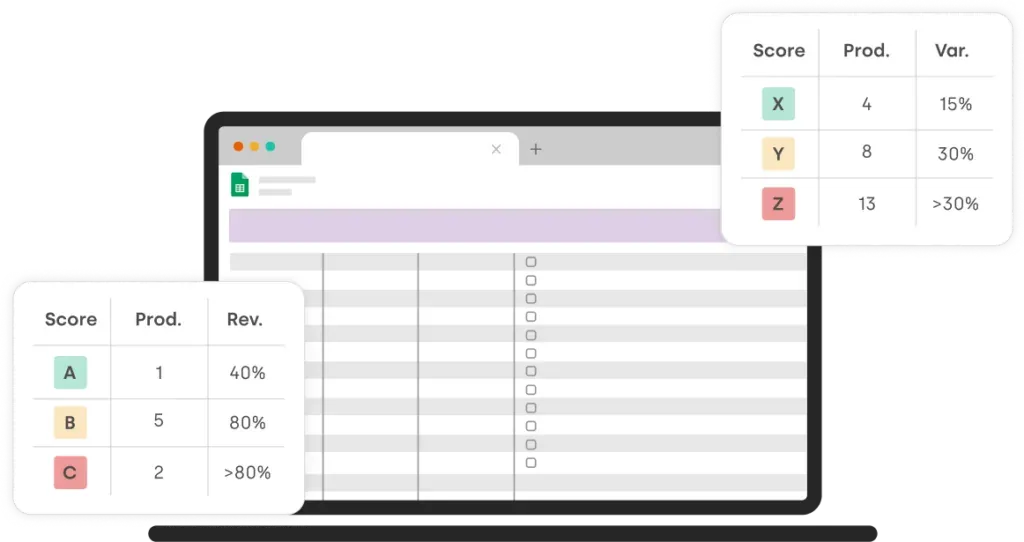
Identify and prioritize your most important products with our ABC XYZ classification template in Excel. Download it now and focus your efforts!
Marketing strategies for each stage of a product’s life cycle
Marketing strategies are essential to a product’s success throughout its life cycle. These techniques allow companies to identify their market’s needs and adapt their strategies accordingly.
Throughout the product life cycle, marketing strategies can help increase the product’s visibility and demand, build loyalty among existing customers and attract new consumers. They also help keep the company relevant in a constantly evolving market and face competition effectively.
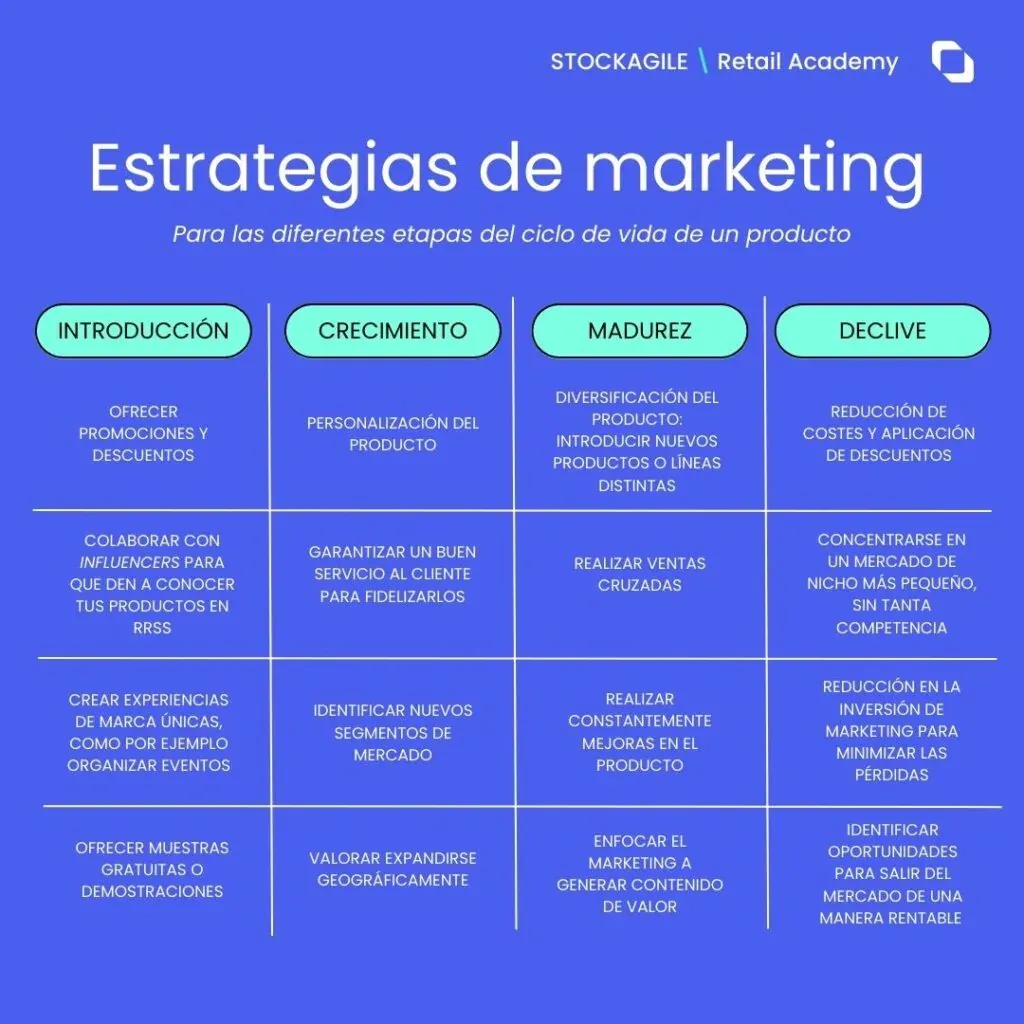
Here are some marketing strategies you can use at each phase of the product life cycle:
1. Marketing strategies during the introduction stage
During the introduction phase, it’s important to build brand awareness and generate demand for the product. Some effective marketing strategies for this phase include:
-
Promotions: Offering promotions, such as discounts or free samples, helps attract customers and creates an incentive to try the product.
-
Demonstrations: Showing how the product works is a great way to catch the attention of potential customers and help them understand how the product can benefit them, so they decide to buy it.
-
Influencer marketing: Turning to social media influencers is a good option to promote the product and build brand awareness. For example, a clothing brand can collaborate with a fashion influencer to show how to combine the items in its store.
-
Mass media advertising: Using advertising on television, radio and print media to reach a broad audience and build brand awareness. For example, a fast food brand can launch a TV commercial during a major sporting event to reach a large audience. This will also depend on the company’s budget.
-
Creating unique brand experiences: Creating unique, emotional experiences that consumers associate with the brand. For example, a clothing brand can organize an event where it invites its customers and offers a range of appealing activities. Once the event is over, it can share all the photos and videos on social media.
A successful example of a marketing strategy for this stage is the launch of Apple’s first iPhone in 2007. Apple implemented various strategies to make the product known, such as television advertising, a limited release and fostering exclusivity, which generated huge demand among consumers and helped establish the iPhone as a high-end, exclusive product.

2. Marketing strategies during the growth stage
During the growth phase, the goal is to increase market share and build a base of loyal customers. Some effective marketing strategies for this phase include:
-
Product customization: Offering customization options to meet consumers’ specific needs and wants. For example, an athletic footwear brand can offer online customization options so consumers can design their own sneakers.
-
Exceptional customer service: Offering exceptional customer service to build customer loyalty and increase brand loyalty. For example, an electronics brand can offer free technical support and an extended warranty on its products.
-
Market expansion: Identifying new market segments or expanding geographically to increase market share. For example, a coffee brand can expand into new international markets to grow its global presence.
An example of a textile brand that has gone through a successful growth phase is Zara, the Spanish fashion retail chain. During the 1990s and 2000s, Zara expanded rapidly on an international scale, opening stores all over the world and increasing its online presence.

The brand has succeeded by implementing differentiation strategies, such as producing small quantities of clothing with exclusive designs, which has helped create a sense of exclusivity and novelty among consumers.
In addition, its “fast fashion” business model has allowed it to quickly adapt to the latest fashion trends and offer new collections in a short time.
3. Marketing strategies during the maturity stage
During the maturity stage, the goal is to maintain market share and generate consistent profits. Some effective marketing strategies for this phase include:
-
Product diversification: Introducing new products or services to meet consumers’ changing needs and wants and to attract new market segments. In the case of a fashion store, it could add new lines in its stores, such as maternity, teen and plus sizes (if it doesn’t already carry them).
-
Cross-selling: The company can offer complementary or related products to encourage customers to buy more. For example, a camera brand can offer discounts on camera accessories when you buy a new camera.
-
Continuous innovation: Constantly improving existing products or services to keep up with market trends and expectations. For example, a technology brand can regularly update its software and hardware to improve performance and the user experience.
-
Value-based content marketing: Emphasizing the benefits and value of products or services to maintain loyalty among existing customers and attract new ones. For example, a personal care brand can highlight the natural ingredients and quality of its products in its marketing campaign, or write articles of interest for its target audience on a blog included on its website.
-
Cost-based competition: Reducing production costs and the prices of products or services to stay competitive in the market. For example, a clothing brand can reduce production costs by using cheaper materials or by outsourcing production to other countries.
During the maturity stage, Kellogg’s implemented several marketing strategies to maintain its position in the breakfast cereal market. The brand launched an advertising campaign comparing its product with the competition’s, highlighting the superior quality and taste of Kellogg’s cereals.
It also focused on product innovation to meet customer demands, launching new products such as organic and gluten-free cereals.
Finally, the brand also offered cross-selling promotions to encourage customers to buy more products, such as discounts on cereal bars and dried fruit when buying a box of cereal.
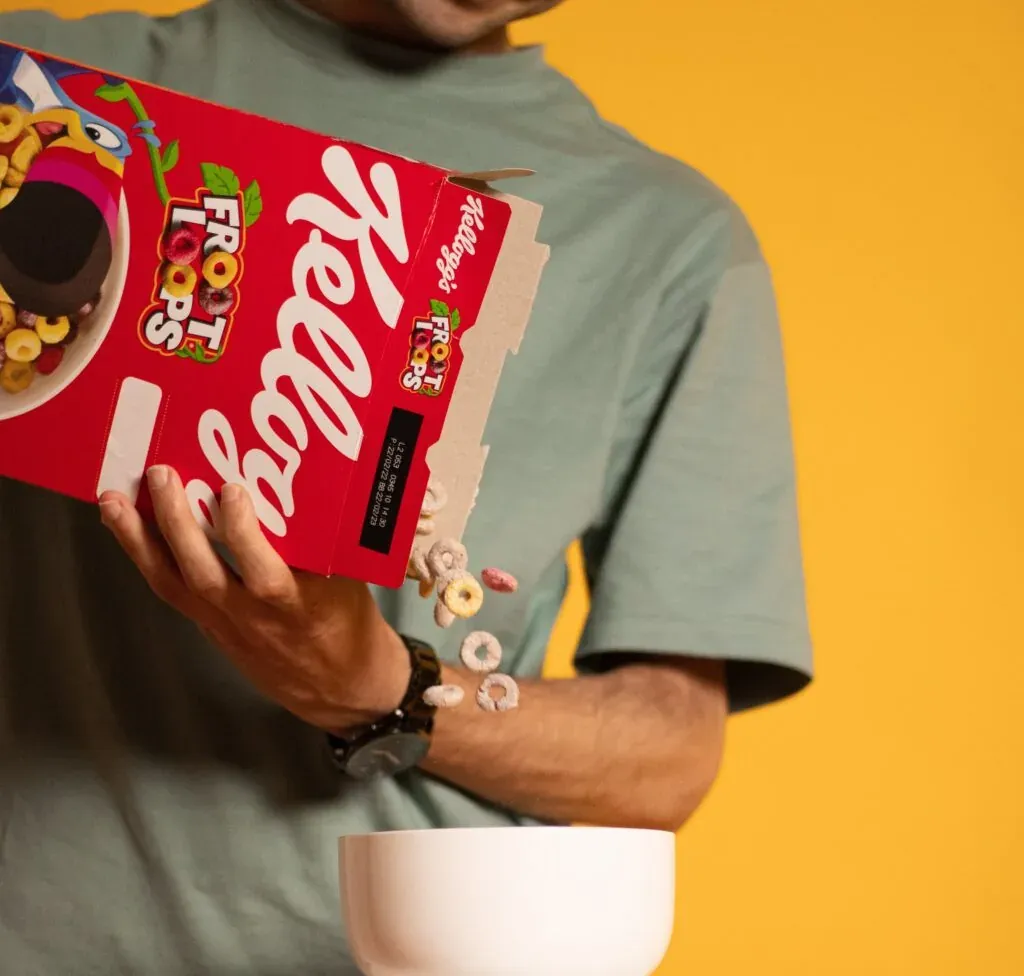
These marketing strategies were effective in keeping Kellogg’s a leading brand in its category, despite growing competition in the market.
4. Marketing strategies during the decline stage
During the decline stage, the goal is to maintain profitability and minimize losses. Some effective marketing strategies for this phase include:
-
Exit strategies: Identifying opportunities to leave the market profitably, such as selling off assets or an orderly liquidation of inventory.
-
Cost reduction and discounts: Reducing production prices and overhead costs to increase profitability. For example, a brand can cut costs by switching to cheaper materials and eliminating products that don’t sell well. Another option is to offer discounts to get products to sell.
-
Focus on the niche market: Concentrating on a smaller, more profitable niche market instead of trying to compete in a larger, saturated one. For example, a cleaning products brand can focus on cleaning swimming pools or boats.
-
Brand repositioning: Changing the brand image and marketing strategy to attract new market segments or to improve the brand’s perception in the current market. For example, a motorcycle brand can shift its focus from speed and excitement to safety and reliability.
-
Reducing marketing investment: Cutting spending on advertising and promotions to maximize profitability and minimize losses. For example, a brand can reduce spending on traditional advertising and focus on low-cost or organic digital marketing.
During the 1990s, Kodak faced growing competition from digital cameras. As technology advanced, demand for traditional cameras declined, which pushed Kodak into the decline stage.
To adapt to this situation, the company implemented several marketing strategies, including price reductions, diversification into digital photo printing, and the sale of patents to obtain additional revenue.

Despite these strategies, Kodak ultimately filed for bankruptcy in 2012. Even so, this is a good example that shows how marketing strategies can help companies face the decline stage and stay in the market, even if they aren’t always enough to save the company.
Optimize the management of your products’ life cycle with Stockagile.
With Stockagile, you’ll be able to track your product’s inventory and update it in real time, giving you a clear view of how it’s performing in the market. You’ll also have access to data analysis and management tools that will help you make informed decisions at every stage of the product life cycle.
In the product’s market introduction phase, our software will let you set an appropriate pricing strategy and manage customer orders.
In the growth phase, it will help you manage inventory and plan production according to demand.
In the maturity phase, you’ll be able to analyze sales data and adjust your marketing strategy to keep the product relevant in the market.
And finally, in the decline phase, you’ll be able to manage inventory efficiently and make informed decisions about whether it’s better to withdraw your product or apply discounts to it.